SOL Escape Bivvy Review
A breathable, heat-reflective emergency bivy that trades a little weight for a lot less condensation than the classic space-blanket bivvy.
Overview
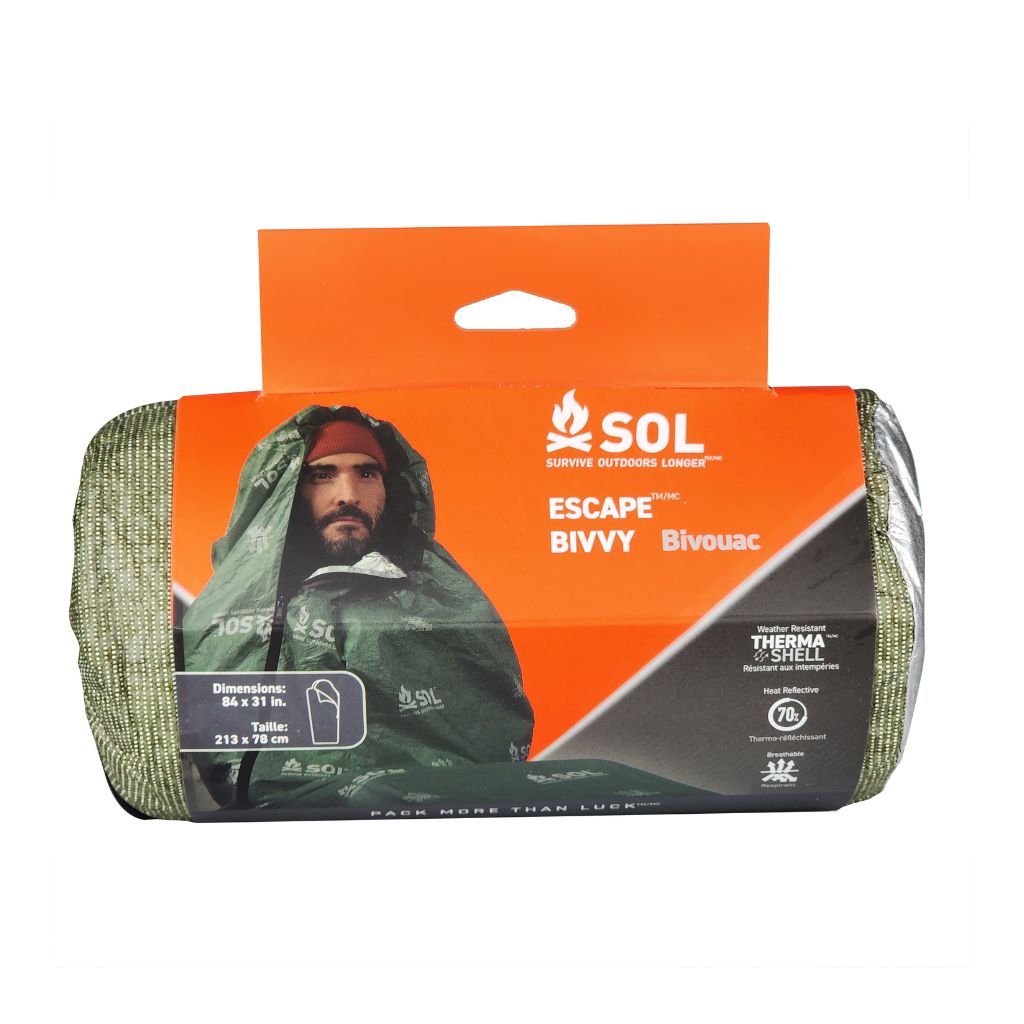
The SOL Escape Bivvy is a step up from the disposable mylar emergency bags you see clipped to keychains — it’s built from a spunbonded olefin fabric with a metalized coating (SOL calls it Escape ThermaShell) that’s designed to reflect body heat back at you while still letting water vapor escape. It’s aimed at backpackers, hikers, and trail runners who want a reusable “just in case” shelter that won’t turn into a sweaty plastic bag the moment you fall asleep in it, and it can double as an ultralight standalone shelter in mild conditions or a warmth-boosting liner inside an existing bag.
Key Specs
| Spec | Detail |
|---|---|
| Weight (Regular) | 8.5 oz / 241 g |
| Weight (XL) | 9.5 oz / 269 g |
| Dimensions | 84 x 31 in |
| Heat reflectivity | 70% of radiated body heat |
| Material | Escape ThermaShell (spunbonded olefin, metalized coating) |
| Closure | Full hood with draw cord, 23-in side zipper |
| Foot box | Fully formed |
| Colors | Orange, OD Green |
| Reusable | Yes |

Build your Gear Closet
View all of your gear in one place, create packing lists and hit the trail with confidence. Available on iOS, Android and the web.
Get StartedPerformance
The core pitch of the Escape Bivvy is that it solves the biggest complaint people have with cheap mylar emergency bags: condensation. A basic space-blanket bivvy traps every bit of moisture from your breath and skin, and within an hour or two you’re lying in a puddle of your own sweat. SOL’s fabric is built to let that vapor escape while still bouncing infrared heat back at your body, and independent testing backs up the general concept — the material averages an air permeability of .67 CFM, compared to just .5 CFM for the most breathable version of eVent, so condensation avoidance should be comparable to eVent.
That said, “breathable” is relative, and it doesn’t mean condensation-free. Multiple users report that in warmer, short-duration use the bivvy performs close to advertised, but the picture changes as temperatures drop. One long-term tester noted getting some condensation on the inside which was slightly annoying, but sleeping ok, though when temps dropped into the 30s he needed something with less condensation. That’s a useful data point: this isn’t a bag that eliminates moisture buildup in cold, sustained use — it just delays and reduces it compared to non-breathable alternatives. Sectionhiker’s review of the similar Escape Pro Bivvy echoes this: the reviewer would expect clamminess to become condensation in some situations, but not nearly to the extent you’d find with a non-breathable mylar bag.
As a standalone shelter, don’t expect much room to spare. One 6’2” tester with broad shoulders reported that it wasn’t a roomy fit, but he was able to fully get inside of it. If you’re tall or claustrophobic, the Regular size is going to feel snug — which is exactly why SOL sells the XL at a 1-ounce weight penalty. Durability has held up better than you’d expect from a fabric this thin; Outdoor Gear Lab’s testers used theirs on and off for over a year and noted it has held up well, which is asking a lot from an inexpensive emergency bivy.
The reflectivity claim deserves a reality check, too. A well-known thread on Backpacking Light dug into the physics and found the aluminized layer’s actual measured performance backed up the manufacturer’s numbers, but outside reviewers are quick to point out that radiant heat loss is only part of the equation — radiant heat loss is smaller than loss through convection and conduction, these bivy sacks offer no insulation, and your clothing layer alone already reduces radiant heat significantly. In other words, the 70% number is real under lab conditions, but it won’t make an un-insulated night in freezing temps comfortable — you still need clothing or a pad underneath for actual insulation.
Packed size is reasonable for what it does: it packs a lot into a relatively small package at 8.5 ounces and roughly the size of a 32-ounce Nalgene bottle. That’s not pocket-sized like the paper-thin emergency blankets, but it’s a fair trade for the added durability, zipper, and hood.
Pros & Cons
Pros
- Genuinely more breathable than mylar-style emergency bivvies, especially for shorter or warmer-weather use
- Reusable and durable enough for repeated trips, not a one-and-done item
- Full hood, drawcord, and 23-inch side zip make it easier to seal out wind and rain than basic bags
- Doubles as a sleeping bag liner for a warmth boost, or a standalone shelter in mild conditions
- High-visibility orange option aids rescue visibility
Cons
- Condensation still shows up in sustained cold-weather use — it manages moisture, it doesn’t eliminate it
- Snug fit for taller/broader users in the Regular size
- No insulation of its own — reflectivity claims don’t replace a pad or insulating layers
- Not a substitute for a real UL sleeping bag or quilt on a planned trip; this is a backup tool
Who Should Buy This
This is the right call for backpackers, trail runners, and hunters who want a credible “worst-case night out” shelter in their kit and are willing to carry a bit more than the cheapest emergency blanket to get better breathability and reusability. It’s also a smart, inexpensive way to add 10-15 degrees of warmth to an existing quilt or bag as a liner. It’s not the tool for someone planning to sleep in it night after night on a thru-hike — for that, you want a dedicated ultralight sleeping bag or quilt with real loft.
Verdict
The SOL Escape Bivvy delivers real improvement over basic emergency bivvies in the condensation department, though it’s not the condensation-free miracle the marketing implies once temperatures drop into the 30s. For its weight and price, it’s a solid piece of emergency redundancy that most backpackers should be comfortable stashing in the bottom of their pack. I’d rate it a 7.5/10 — dependable and reusable, just don’t mistake it for a real sleep system.