Millet Light Down 0° Review
Millet's Light Down 0° pairs water-repellent K Dry duck down with H-baffles in a 710–730 g mummy bag, but 700 FP fill holds back its warmth-to-weight.
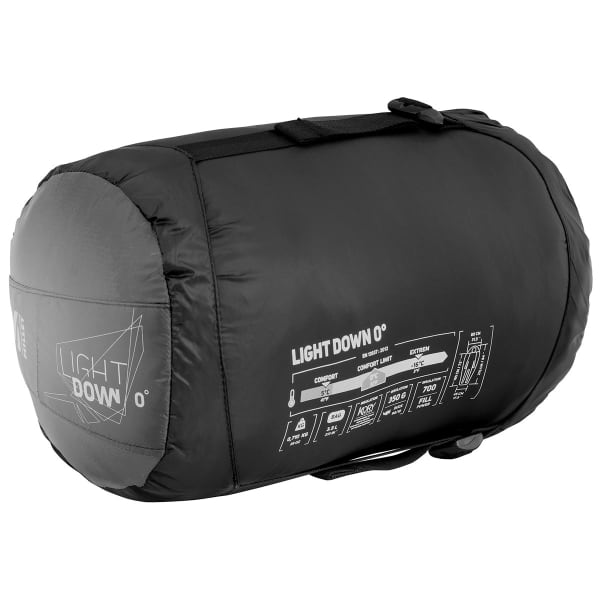
Overview
The Millet Light Down 0° is a three-season mummy bag built for mountain bivouacs and summer trekking, with a 5°C comfort rating and a 0°C limit. Its selling point is K Dry, Millet’s water-repellent treatment for the down, which suits the tent condensation and pre-dawn mist of the Alps and Pyrenees. The trade-off is the fill: 700-fill duck down puts the bag at 710–730 g, heavier than the best ultralight bags with similar ratings.
Key Specs
| Spec | Value |
|---|---|
| Weight | 710–730 g (25.0–25.8 oz) depending on version |
| Comfort / Limit / Extreme | 5°C / 0°C / -16°C (41°F / 32°F / 3°F) |
| Insulation | K Dry duck down, RDS-certified, 90% down / 10% feather |
| Fill power | 700 FP |
| Down weight | 350 g |
| Construction | H-chamber baffles |
| Shell | 20D polyester ripstop, PFC-free water-repellent finish |
| Packed volume | 3.5 L (30 × 16 cm compression sack) |
| Length | 215 cm |
| Max user height | 185 cm (6’1”) |
| Shoulder width | 80 cm |
| Zip | 3/4 side zip, two-way slider, left-hand |
| Extras | Draft flap, insulated collar, double-drawcord hood, inner pocket, mesh storage sack |
Versions compared
| Image | Version | Weight | vs. lightest |
|---|---|---|---|
| 710 g | 710 g (25.0 oz) | lightest |
 | 730 g | 730 g (25.8 oz) | +20 g |

Build your Gear Closet
View all of your gear in one place, create packing lists and hit the trail with confidence. Available on iOS, Android and the web.
Get StartedPerformance
Warmth. The numbers set the expectations. At the 5°C comfort rating, a relaxed sleeper on their back should stay warm. At the 0°C limit, a sleeper has to curl up to hold heat. The -16°C extreme figure is a survival threshold and not a planning number. Cold sleepers should treat this as a summer and shoulder-season bag and carry a base layer for nights near freezing. Owners report better results than the ratings suggest. One German buyer spent a night outdoors in a barrel-style bivouac at -1°C and called the bag warm. An Italian buyer found it very warm over an inflatable pad.
K Dry down. Millet treats the down itself with a PFC-free water-repellent finish, and the shell has its own coating. The aim is a bag that resists absorbing moisture and dries quickly when condensation or humidity gets in. Retailers pitch it as protection against morning dew and tent condensation. It buys margin in a damp bivouac. It doesn’t replace a waterproof shelter, and a soaked down bag is still a problem.
Fill power and weight. The 700 FP duck down is what holds the bag back. Higher-fill goose down gives the same loft from less material, which is why lighter bags at this rating exist. About 350 g of the total weight is down. Millet’s own price is €280. At that price, the fill is the weak spot.
Construction. H-chamber baffles use internal walls instead of stitched-through seams, so there are no thermal bridges and the down stays where it’s placed. It’s the classic design for a bag aimed at comfort and compressibility. The 20D ripstop shell is sturdier than the 10–15D fabrics on race-weight bags, and it’s part of why the weight stays above the ultralight benchmark.
Fit and features. The cut is a standard mummy with 80 cm shoulders and 215 cm of length, sized for users up to 185 cm. The 3/4 side zip keeps the foot box sealed and saves a little weight. The cost is ventilation, because the bag can’t be opened flat on a warm night. The two-way slider lets sleepers crack it from the bottom. An internal draft flap covers the zip, and the collar and double-drawcord hood close the neck. Owners single out the finishing: an inner pocket, glow-tipped zipper pulls, and a mesh storage sack. Buyers also praise the small, light packed size.
Packed size. At 3.5 L, the bag fits a 30 × 16 cm sack. That’s compact enough for the bottom of a 40–50 L pack. It isn’t the smallest in its class.
Choosing a Version
Both listed versions are the same bag. The 710 g and 730 g versions share the same temperature ratings, 3.5 L packed volume, 215 cm length, 80 cm shoulders and 185 cm height limit. They also share the same 90/10 duck down fill and 3/4 side zip. The 20 g gap (under an ounce) is too small to affect warmth, fit or packed size. Retailer listings for the bag run slightly higher, up to 740 g, which suggests unit-to-unit variation.
Buy whichever is in stock. A hiker who is counting every gram should check the actual weight on a scale before the first trip.
Pros & Cons
Pros
- K Dry treatment on both the down and the shell resists damp, condensation-prone conditions
- H-chamber baffles avoid cold spots without adding bulk
- Draft flap, insulated collar and double-drawcord hood seal in heat at the limit rating
- Two-way 3/4 zip gives some venting while keeping the foot box warm
- RDS-certified down and PFC-free finish
- Ships with a compression sack and a mesh storage sack
- Owners report good warmth and a small packed size
Cons
- 700 FP duck down means worse warmth-to-weight than higher-fill goose down bags
- 710–730 g is heavy for a 0°C-limit bag by ultralight standards
- A 5°C comfort rating leaves cold sleepers needing a base layer on mild nights
- The 3/4 zip limits ventilation on warm nights
- The left-hand zip and 185 cm height limit rule out taller or right-zip-preferring sleepers
- €280 is a lot for the fill power
Who Should Buy This
The Light Down 0° suits the alpine trekker doing multi-day routes where summer nights approach freezing and tents drip by morning. It also fits hut-to-hut hikers and bikepackers who want a compact down bag that tolerates damp. Thru-hikers chasing the lowest base weight should look at 800-fill-plus goose down bags. Hikers over 185 cm, and anyone who sleeps cold, need a longer or warmer bag.
Verdict
The Millet Light Down 0° is a well-made, damp-tolerant mountain bag with good features and credible environmental credentials. The 700 FP duck down costs it weight and value against lighter, similarly priced rivals. It earns a 6.5 out of 10: a sound choice for wet alpine use and a poor one for hikers who count grams.