NEMO Hornet Review
The NEMO Hornet packs two doors and two vestibules into a semi-freestanding double-wall tent of 851 g (Standard) or 948 g (OSMO). It sleeps one well and two tightly.
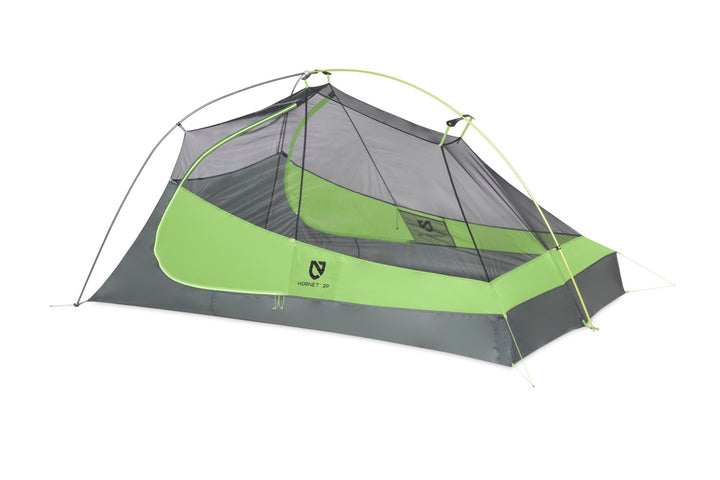
Overview
The NEMO Hornet is a semi-freestanding, double-wall backpacking tent with two doors and two vestibules, at 851 g in Standard trim or 948 g in the OSMO version. It is for hikers who want a conventional pole-supported tent with side entry and real gear storage, without the weight penalty of a roomier shelter. The trade-off is interior geometry: it is a generous solo tent and an intimate two-person one, and anyone over six feet will notice the sloping walls.
Key Specs
| Spec | Detail |
|---|---|
| Weight | 851–948 g depending on version |
| Capacity | 2-person |
| Design | Semi-freestanding, single-hub pole |
| Poles | DAC Featherlite |
| Doors / vestibules | 2 / 2 |
| Floor dimensions | 85 x 51/43 in (tapers at the foot) |
| Floor area | 27.5 sq ft |
| Vestibule area | 7.1 sq ft each |
| Peak height | 39 in |
| Packed size | About 19.5 x 5.5 in |
| Wall construction | Double wall |
| Fly fabric | Standard: 10D silicone/PU nylon ripstop, 1,200 mm rating. OSMO: recycled nylon/polyester blend |
| Seasons | 3-season |
Versions compared
| Image | Version | Weight | vs. lightest |
|---|---|---|---|
| Standard 2P | 851 g (30.0 oz) | lightest |
 | OSMO 2P | 948 g (33.4 oz) | +97 g |

Build your Gear Closet
View all of your gear in one place, create packing lists and hit the trail with confidence. Available on iOS, Android and the web.
Get StartedPerformance
Weight and packability. The Hornet’s appeal starts with a simple comparison: double-wall tents with two doors and two vestibules rarely get this light. CleverHiker’s testers called the combination uncommon in this weight class, and Backpackers.com described the tent as extremely light for a two-person shelter while noting that going lighter means giving up meaningful features. Outdoor Gear Lab’s testers were less charitable on the scale, scoring the weight middling against pure ultralight competitors, though still light next to a conventional backpacking tent, particularly with the load split between two people. The packed bundle is a long, slim roll, roughly 19.5 by 5.5 inches, that slides down the side of a pack more easily than it stuffs into the bottom. NEMO’s Divvy dual-stage stuff sack lets a pair split body and fly or poles between two packs.
Setup. A single hub pole forms the main structure. The head end stands on its own, while the two foot corners need stakes to pull the shape out and to pitch the fly properly. Reviewers describe the process as quick and intuitive. Outdoor Gear Lab gave the OSMO a 9.5 for ease of setup. Semi-freestanding means soft or rocky ground is less of a problem than with a fully non-freestanding shelter, and because the poles are the frame, trekking poles stay free for day hikes from a base camp. Pitching it freestanding in a pinch is possible, but testers advise against counting on it in weather.
Livability. NEMO’s Flybar clips replace conventional body clips on the center pole, pushing the walls outward and adding head room. That helps, but a 39-inch peak is low and reviewers consistently mention the slope of the walls. A six-foot tester at Blister found the layout workable; CleverHiker’s 6’2” tester found both the length and the peak too tight; and a 5’11” reviewer at Backwoods Pursuit reported having to choose between head or feet touching fabric. For two, the foot narrows to 43 inches, which fits two 20-inch pads with little margin, and Backpackers.com characterized capacity as closer to one and a half people. Owners generally treat the Hornet as a roomy one-person tent with a big gear footprint. Partners who like each other will be fine. Everyone else should look at NEMO’s Dagger or Dragonfly.
Doors and vestibules. Each side gets its own door and a 7.1 sq ft vestibule, so nobody climbs over anyone at 2 a.m. and boots and packs stay dry on separate sides. Reviewers call the vestibules small but usable, enough for a mid-size pack and a pair of boots. The D-shaped doors are modest, but they do the job.
Weather and ventilation. The mesh inner and the gap between fly and body keep air moving, and Blister noted that the tent breathes well, particularly at the head end, despite having no adjustable vents. The flip side is less warmth in cold conditions. Double-wall construction keeps condensation off sleeping bags provided the fly is tensioned correctly. Outdoor Gear Lab’s testers praised the rain protection but found the poles flex noticeably in heavy gusts. Testers describe the Hornet as a competent three-season shelter, not one for exposed ridgelines above treeline or for winter.
Durability. Light fabrics are the compromise behind the weight. The Standard fly is silicone-treated on the outside and polyurethane-coated underneath, tough for its denier but not a tent to pitch on gravel or drag over talus. A footprint is a sensible add-on, and owners who skip one report that the floor is the first place wear shows. One long-term owner reports that the inner mesh near the pole connection loop is prone to tearing over time. NEMO backs the tent with its lifetime warranty.
Choosing a Version
The two versions share the same floor plan, pole structure, door layout and 39-inch peak. What changes is the fabric, and 97 g.
Standard 2P (851 g) is the lighter of the pair, and the one for hikers counting every gram. Its silicone/PU nylon fly is conventional for the category, which means it can stretch and sag when it gets wet, and a tight pitch sometimes needs a mid-night adjustment.
OSMO 2P (948 g) swaps in NEMO’s proprietary OSMO fabric, woven from 100 percent recycled nylon and polyester yarns. According to NEMO, the nylon is 20 percent stronger than standard nylon, the polyester resists stretching when wet by a factor of three, and water resistance is up fourfold, all with a PFAS-free finish. Reviewers testing the OSMO report a fly that holds tension through damp nights and temperature swings, which is what the extra weight buys. Outdoor Gear Lab rated its livability higher than the older Hornet and ranked it 12th of 15 in its ultralight tent test, mostly on weight. For hikers who camp in wet climates such as the Cascades or Appalachians, or who dislike getting out of a sleeping bag to re-tension guylines, the extra 97 g is a fair price.
Pros & Cons
Pros
- Two doors and two vestibules at 851–948 g in a double-wall tent
- Quick, intuitive pitch from a single DAC Featherlite pole, with trekking poles left free
- Flybar clips add head room at the top of the tent
- Side entry and separate vestibules make both solo and shared use easier
- Good airflow and condensation management for a double-wall design
- OSMO version resists sagging when wet
- Slim packed shape and a Divvy sack for splitting loads
Cons
- Tight for two; the floor narrows to 43 in at the foot
- A 39 in peak and sloping walls are a poor fit above six feet
- Foot corners must be staked out for a proper pitch
- Thin fabrics need careful site selection and likely a footprint
- Poles flex in strong wind; not for winter or exposed alpine camps
- OSMO adds 97 g
Who Should Buy This
The Hornet suits solo thru-hikers and weekend backpackers who want a double-wall tent with room for gear and an easy pitch. It also works for couples who value weight over elbow room and sleep on narrow pads. Tall hikers, couples who want breathing room, and anyone planning to camp above treeline in serious weather should look at something longer, taller or sturdier. Weight-focused hikers in dry regions should take the Standard; those who expect rain should take the OSMO.
Verdict
The Hornet delivers features usually reserved for heavier tents, at a weight few double-wall competitors match, with a pitch that takes minutes to learn. Buy it as a generous solo shelter or a deliberately cozy two-person one, and plan on a footprint. The OSMO is the better choice for most hikers; the Standard is for those who will happily trade fabric performance for 97 g.