MSR Mutha Hubba NX Review
MSR's freestanding 3-person Mutha Hubba NX trades a few ounces and some condensation for near-vertical walls, two doors and room for two plus gear.
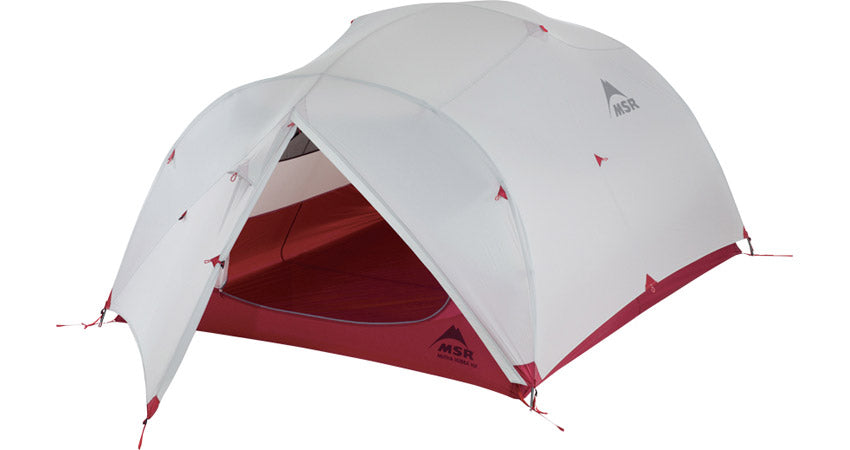
Overview
The Mutha Hubba NX is MSR’s freestanding, three-season, three-person tent: two doors, two vestibules, and a single hubbed pole set that goes up without much thought. It is built for couples who want elbow room and for small groups who value livability over grams. The trade-off is a tent that is heavy for one or two hikers, and one that gets damp inside when the fly is fully battened down.
Key Specs
| Spec | Detail |
|---|---|
| Capacity | 3-person |
| Season rating | 3-season |
| Weight | 611–2,070 g depending on version (2,070 g minimum weight for the complete tent) |
| Fast-and-light weight | 1,660 g |
| Floor area | 39 sq ft (about 3.6 m²) |
| Peak height | 112 cm (44 in) |
| Packed size | 60 x 22 x 22 cm |
| Fly | 20D nylon ripstop, Durashield PU coating, 1,200 mm hydrostatic head |
| Floor | 30D nylon ripstop, Durashield PU coating, 3,000 mm hydrostatic head |
| Doors / vestibules | 2 / 2 |
| Frame | Aluminum hub-and-pole system, freestanding |
| MSRP | $549.95 |
Versions compared
| Image | Version | Weight | vs. lightest |
|---|---|---|---|
 | Poles | 611 g (21.6 oz) | lightest |
| Standard | 2070 g (73.0 oz) | +1459 g |

Build your Gear Closet
View all of your gear in one place, create packing lists and hit the trail with confidence. Available on iOS, Android and the web.
Get StartedPerformance
Space. Livability is the Mutha Hubba’s calling card. The pole geometry pushes the walls close to vertical, so the 39 sq ft floor feels bigger than the number suggests. Reviewers who have pitched it in Wyoming and the Pacific Northwest describe it as a roomy two-person tent, not a snug three-person one. Backcountry Skiing Canada’s testers called it roomy for two plus gear and workable for three, which is about right: three sleepers fit, but they will be shoulder to shoulder with gear in the vestibules. Six interior mesh pockets give wet socks, headlamps and phones somewhere to live.
Setup. A single hubbed pole with color-coded attachment points makes this one of the easier tents to pitch solo. An owner who had never pitched one reported a complete setup, guylines included, in about 15 minutes. The fly’s door panels are colored red, which helps orient it in a breeze. The tent body can be pitched on its own on warm, dry nights. MSR also sells a footprint, but it costs extra and adds weight.
Weather and ventilation. The fly’s kickstand vent lines up with a mesh window on the inner tent to keep air moving. Each door has a built-in rain gutter, so water doesn’t run in when a door is opened in a downpour. Mountain Weekly News found the full-coverage fly kept rain out and the venting handled overnight breath moisture better than most. Others disagree. Halfway Anywhere’s reviewer reports condensation building up with the fly fully closed, particularly with three people breathing inside, and rated the tent poorly on that measure. Pitching with the vents open and the vestibules rolled back helps, but that is a three-season tent’s limit, not a flaw to engineer around.
Vestibules. Total vestibule area is about 14 sq ft across both doors. That works for two packs and boots, but reviewers call the individual vestibules small. In a three-person configuration, someone’s pack is probably coming inside.
Weight and packability. At 2,070 g minimum weight, the Mutha Hubba is light for a three-person tent. Mountain Weekly News noted that earlier versions weighed less than plenty of two-person models. It is heavy for two ultralight hikers who would be fine in a smaller shelter. Dropping to the 1,660 g fast-and-light configuration saves about 410 g. The 60 x 22 x 22 cm packed size is smaller than most three-person tents, and the side-loading compression sack folds inward to fit awkward pack shapes.
Durability. The 20D fly and 30D floor are standard for the category, not special. The 1,200 mm and 3,000 mm hydrostatic head ratings are typical of PU-coated backpacking tents. MSR backs the tent with a three-year warranty.
Choosing a Version
The two versions are not alternatives to each other.
- Standard (2,070 g): The complete tent, and the one nearly every buyer wants. It includes the body, fly, poles, stakes and guylines. Its 2,070 g figure is the minimum weight, with the stuff sack and extras left out.
- Poles (611 g): The pole set alone. That’s roughly 30 percent of the tent’s minimum weight. It is the choice for an owner replacing a bent or broken frame, not for anyone buying a first shelter.
Anyone shopping for a tent should buy the Standard.
Pros & Cons
Pros
- Near-vertical walls make a 39 sq ft floor feel generous for two people
- Single hubbed pole, color-coded attachments, easy solo pitch
- Two doors and two vestibules mean no climbing over a tentmate
- Small packed size (60 x 22 x 22 cm) for a three-person tent
- Fly can be dropped for tent-body-only camping on clear nights
- Six interior pockets
Cons
- Condensation builds with the fly closed, especially with three occupants
- Vestibules are small for three people’s gear
- 2,070 g is heavy for solo or ultralight duo use
- Footprint costs extra
- At $549.95, it costs more than many two-person options
Who Should Buy This
Couples who want a roomy freestanding tent and don’t mind carrying about a kilogram each. Small groups of three who accept a close fit in exchange for a weight that splits easily. Hikers who camp in humid valleys or cold shoulder-season nights should look elsewhere, or plan to pitch with the vents open. Solo hikers and weight-focused duos will do better with a smaller shelter.
Verdict
The Mutha Hubba NX is a well-sorted, easy-to-pitch, comfortable tent that is better as a spacious two-person home than a true three-person one. Its condensation tendencies and small vestibules keep it from an unqualified recommendation. Buy it for livability and fast setup, not for the lightest possible carry.