MSR Hubba Hubba Review
The MSR Hubba Hubba is a freestanding two-person tent with a true rectangular floor and dual doors. It trades a few ounces for real room.
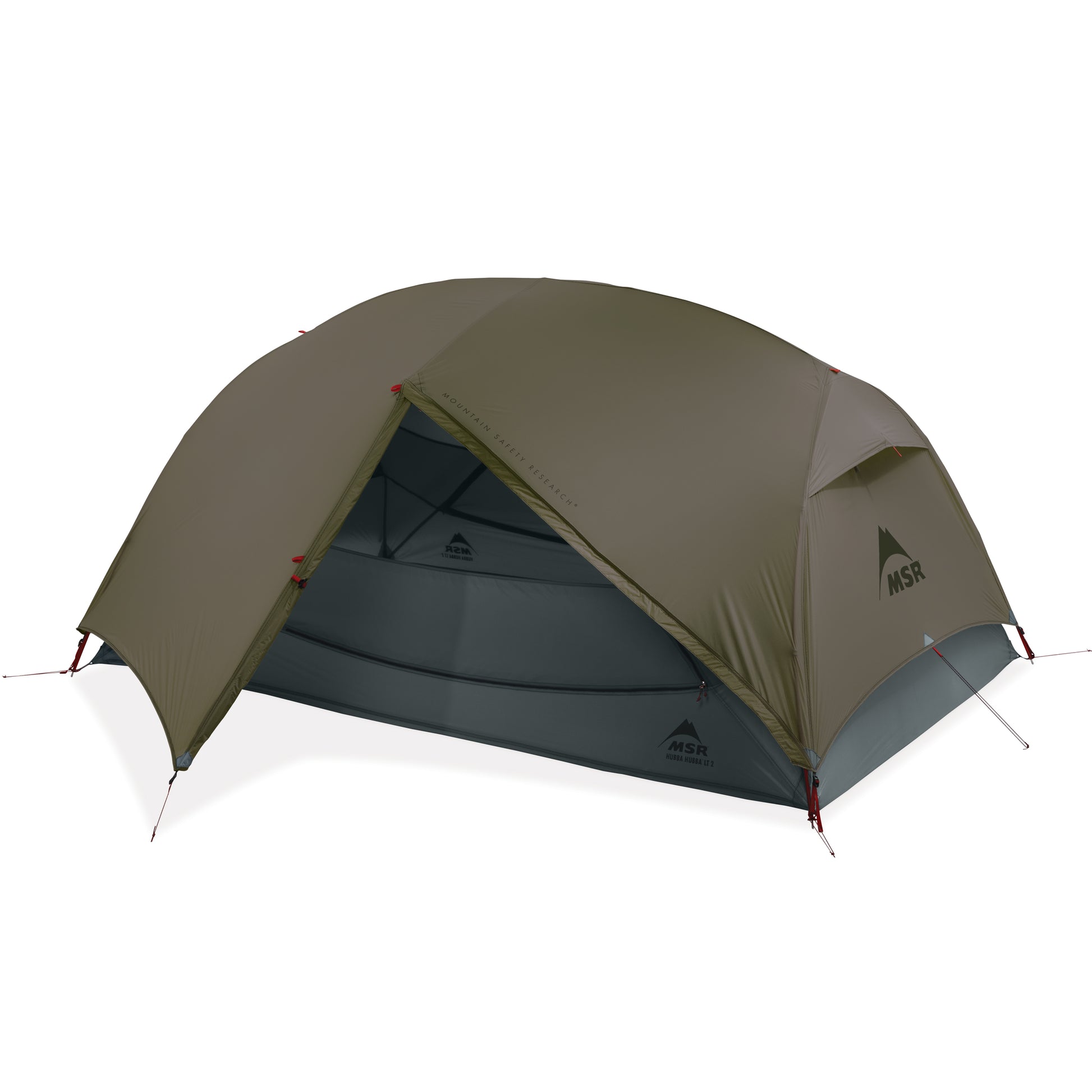
Overview
The Hubba Hubba helped set the template for the modern backpacking tent: a freestanding double-wall shelter with a rectangular floor, two doors, two vestibules and 40 inches of headroom. It comes in two versions, the Standard and the newer LT 2P. Both are aimed at pairs who want to sleep without negotiating over elbow room and can split the carry. The trade-off is plain. Trekking-pole and tapered-floor shelters weigh less, but the Hubba Hubba gives more usable space per gram than most of them.
Key Specs
| Spec | Value |
|---|---|
| Capacity | 2-person |
| Seasons | 3-season |
| Weight | 1,304–1,474 g depending on version |
| Structure | Freestanding, double-wall, single hubbed pole set |
| Peak height | 40 in (1.01 m) |
| Floor dimensions | Standard: 84 × 50 in; LT 2P: 88 × 52 in |
| Floor area | Standard: 29 sq ft; LT 2P: 32 sq ft |
| Doors / vestibules | 2 doors, 2 vestibules (about 8 sq ft each) |
| Poles | Standard: Easton Syclone composite; LT 2P: DAC NFL 9.3 mm aluminum |
| Fly and floor fabric | 20D ripstop nylon with waterproof coatings, taped seams |
| Canopy | 20D ripstop nylon with polyester micromesh |
| Packed size | LT 2P: 20 × 5.5 in (51 × 14 cm) |
| Footprint | Sold separately |
Versions compared
| Image | Version | Weight | vs. lightest |
|---|---|---|---|
| Standard | 1304 g (46.0 oz) | lightest |
 | LT 2P | 1474 g (52.0 oz) | +170 g |

Build your Gear Closet
View all of your gear in one place, create packing lists and hit the trail with confidence. Available on iOS, Android and the web.
Get StartedPerformance
Weight and packability
The Hubba Hubba sits mid-pack among lightweight two-person freestanding tents. The Big Agnes Copper Spur HV UL2 and Nemo Dragonfly Osmo 2P both list 3 lb 2 oz. The Tiger Wall UL2 and Hornet Osmo 2P come in around 2 lb 8 oz, and the Fly Creek HV UL2 around 2 lb 4 oz. Those lighter tents get there with thinner fabric and walls that taper toward the foot end. Split between two hikers, the Standard works out to roughly 650 g each. One LT owner dividing the tent with a spouse put the load at about 24 oz apiece. That is light, he said, but not strictly ultralight.
Livability
The floor is rectangular with no foot taper, and the walls are close to vertical. That means two people on wide pads aren’t pressed against sloping fabric. Hikers sleeping head to foot gain even more shoulder room. The LT stretches the floor to 88 × 52 inches, which is enough for two oversized pads side by side. Both versions have a door and a vestibule on each side, so nobody climbs over a tentmate at 3 a.m. Owners also praise the interior storage: wide mesh pockets at the head and foot, overhead gear lofts and a built-in clothesline for damp socks. Each vestibule is around 8 sq ft. That fits a pack and boots, but it is smaller than the Copper Spur’s and well short of the Nemo Dagger Osmo’s 12.1 sq ft.
Setup
The symmetrical hubbed pole set makes this one of the easier tents to pitch, and solo hikers report getting it up in a couple of minutes. Instructions are sewn into the stuff sack. Owners of the Standard model note that it pitches inner-first, which wets the inside in a downpour. Experienced users get around it by threading the poles through the fly first and clipping the inner in from underneath.
Weather protection
The Standard’s Easton Syclone composite poles are built to flex in gusts and spring back, and one report has the tent holding through a night of Patagonian wind. Both versions have a raised bathtub floor, taped seams and StayDry door gutters that keep rain from dripping into the entry. The tall, steep walls that give the tent its room also catch wind, though. Buyers who regularly camp in exposed, stormy terrain would be better served by a lower, more aerodynamic shape.
A smaller group of LT owners reports weak spots in strong wind and rain. One complaint is that the kickstand vent closure is too flimsy to stay shut in gusts above roughly 20 km/h. Other Reddit commenters raise isolated cases of glue failure. The LT’s fly is 20D nylon rated to 1,200 mm and its floor to 1,800 mm. Wilderness Magazine credits the LT with impressive spaciousness for its weight, but says the light fabric costs durability. Its reviewers recommend a footprint and careful site selection.
Ventilation and condensation
The body is mostly micromesh, with roof and kickstand vents on the fly. Condensation still forms in cold or humid conditions. The double-wall design holds the fly off the inner, so moisture stays on the underside of the fly and doesn’t drip onto sleepers. Owners say wet-weather condensation depends more on venting and campsite choice than on the tent itself.
Choosing a Version
Standard. This is the older design at the lighter listed weight of 1,304 g. Its 84 × 50 in floor (29 sq ft) fits two regular-width pads, and the composite Easton poles are proven in wind. It is also the cheaper option, at about $480. It suits pairs who want the Hubba Hubba layout and value a lower price and weight over extra floor.
LT 2P. At 1,474 g, it is 170 g heavier by listed weight. It adds floor area (32 sq ft), a wider 52 in floor and 20D solution-dyed fabrics with PFAS-free DWR. It swaps composite poles for DAC NFL aluminum and replaces the plastic corner hardware on older models with metal. The MSRP is $549.95. It suits couples who sleep on oversized pads or are tall, and who will put a footprint under it. The LT is the better choice for a pair that wants the roomier floor. The Standard suits one that wants to carry less and spend less.
Pros & Cons
Pros
- True rectangular floor with near-vertical walls, so the room is usable
- Dual doors and dual vestibules
- Fast, symmetrical freestanding pitch that one person can manage
- Good ventilation, and the double wall keeps condensation off sleepers
- Freestanding, so it works on sand, packed dirt and rock platforms
- The LT adds a wider, longer floor and metal corner hardware
Cons
- Heavier than tapered-floor and trekking-pole competitors
- The Standard pitches inner-first, so the inside gets wet in rain
- Tall walls catch wind, and some LT owners report a weak vent closure in gusts
- 20D fabric rewards a footprint, which is sold separately
- Vestibules are modest at about 8 sq ft each
- Premium pricing, especially for the LT
Who Should Buy This
Couples and regular hiking partners should buy this tent. It suits three-season trips where two people split the weight and want an easy pitch and real headroom. It also suits weekend backpackers who see mixed weather. Solo hikers and gram-counters should look at a trekking-pole shelter such as the Durston X-Mid. Hikers who often camp in exposed, high-wind terrain should consider a lower-profile design such as the Durston X-Dome 2.
Verdict
The Hubba Hubba is not the lightest, cheapest or toughest three-season tent. It does combine room, ease of setup and ventilation better than most of its competitors. Pairs that split the load should buy it, choosing the Standard to save weight and money or the LT 2P for the bigger floor.