Durston X-Mid Review
Durston's X-Mid is a trekking-pole double-wall tent with a non-sagging silpoly fly, two doors and real headroom, starting at 720 g for the solo version.

Overview
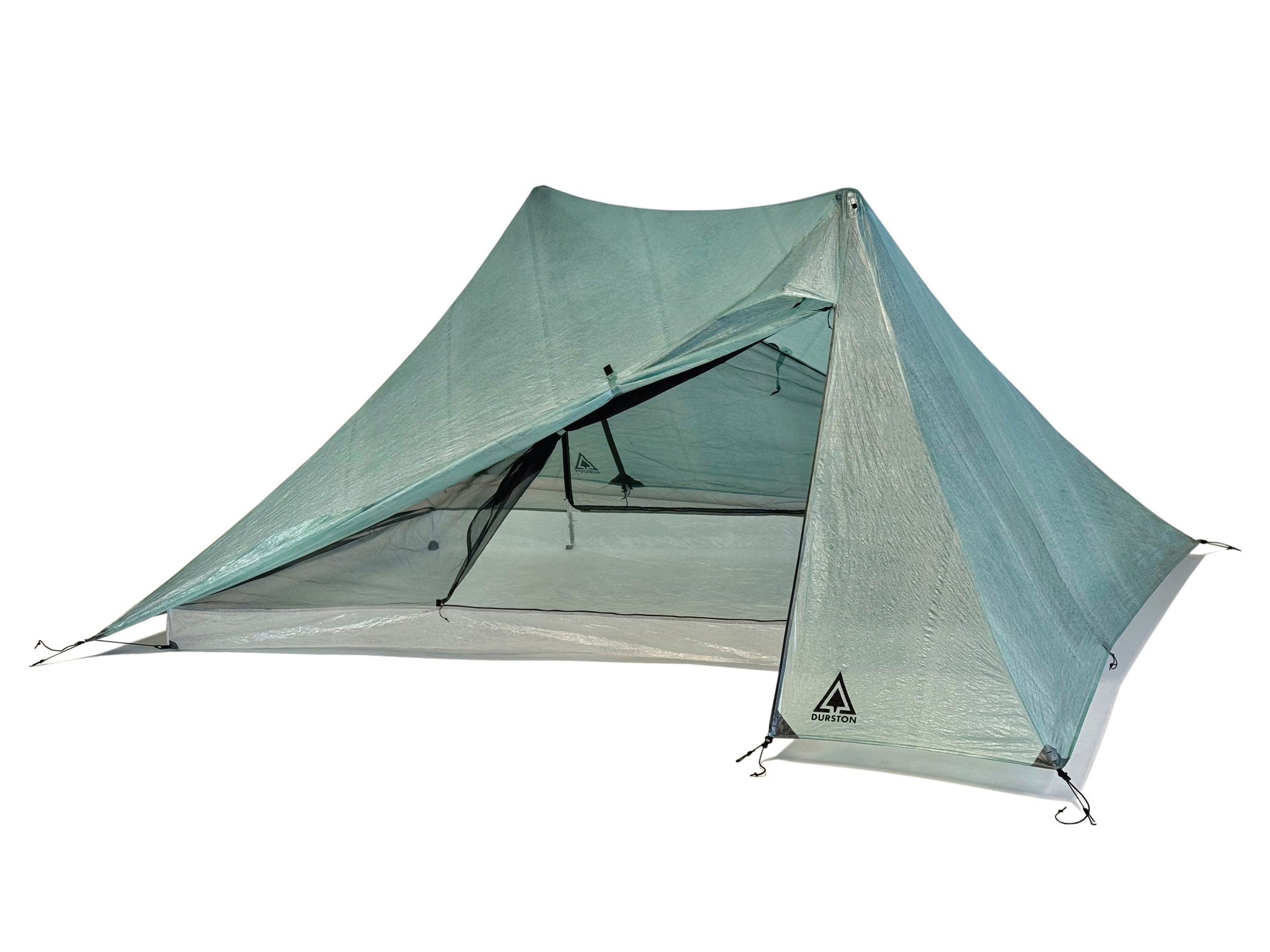
The Durston X-Mid is a double-wall, trekking-pole-supported tent built on a diagonal-ridgeline geometry that buys headroom and storm resistance without a bundle of poles. It comes as a solo X-Mid 1 (720 g in its Gen 3 form) and a two-person X-Mid 2 (880 g), and it targets three-season thru-hikers who want a proper double wall at a weight that used to belong to tarps. The trade-off is the standard one for pole tents: it isn’t freestanding and wants a roomy patch of stakeable ground.
Key Specs
| Spec | Value |
|---|---|
| Capacity | 1P or 2P |
| Weight | 720–1,134 g depending on version |
| Design | Double wall, trekking pole supported |
| Fly fabric | 15D Sil/PE polyester (Gen 3); 3500 mm hydrostatic head on the 1P |
| 1P floor | 93 in × 33 in, about 21 sq ft |
| 1P fly coverage | 45 sq ft |
| 1P headroom | 47 in |
| 1P full kit | About 819 g with eight stakes and stuff sacks |
| 2P floor | 92 in × 52 in, about 33.2 sq ft |
| 2P peak height | About 48 in (current X-Mid 2) |
| 2P fly / inner | About 520 g / 360 g (current X-Mid 2) |
| Doors | Two side doors, each with a vestibule |
| Generation | Gen 3 |
Versions compared
| Image | Version | Weight | vs. lightest |
|---|---|---|---|
| 1 1P | 720 g (25.4 oz) | lightest |
 | 880 g 2P | 880 g (31.0 oz) | +160 g |
| 880 g Drop Collaboration Edition | 1090 g (38.4 oz) | +370 g |
 | 2P Tent Designed by Dan Durston 2P | 1090 g (38.4 oz) | +370 g |
| 880 g Drop Collab Edition | 1134 g (40.0 oz) | +414 g |

Build your Gear Closet
View all of your gear in one place, create packing lists and hit the trail with confidence. Available on iOS, Android and the web.
Get StartedPerformance
Geometry and Livability
The X-Mid’s party trick is its offset layout. A diagonal ridgeline spreads the two trekking poles farther apart than a conventional mid would and keeps them away from the doors. The payoff is headroom along the whole length of the tent: sitting up, changing layers and rolling over don’t involve a negotiation with a center pole.
The inner sits on a diagonal inside the fly, which creates large side vestibules and leaves spare room above the head and foot of the pad, where camp shoes and a headlamp tend to end up. The 1P fits hikers up to about 6’4” and takes wide pads, though anyone near that height will find the mesh close at the ends. The 2P’s 52-inch width fits two wide pads side by side. Switchback Travel’s tester measured its 33.2 sq ft floor well ahead of two popular freestanding 2Ps, the MSR Hubba Hubba LT and Big Agnes Tiger Wall UL 2, at 32 and 28 sq ft.
Gen 3 Changes
Gen 3 is the biggest revision the 1P has had. A new high-tenacity 15D silpoly gives roughly the strength of the previous 20D at about 20 percent less weight, and narrower seams with slimmer tape trim more. Total weight fell by just under 100 g to 720 g. The interior grew at the same time: an inch more width, three inches more length, more vertical mesh walls so shoulders no longer brush the sides, and much larger pockets. The overall footprint shrank.
The 2P got the same treatment in 2025. Durston shaved nearly 140 g from the 2024 model to reach 880 g, down from roughly 1.1 kg for the original 2019 tent, without giving up floor space. A fall 2025 update added fly reinforcements, more double stitching and thicker cordage.
Storm Performance
This is where the X-Mid built its reputation. The offset mid shape handles wind and rain well, and snow tends to slide off the steep fly panels rather than pile up. Owners report riding out 18 hours of steady rain and high wind without worry, and one Reddit commenter said they barely noticed gusts that flattened a friend’s pop-up tents.
Polyester does much of the work. Unlike silnylon, it doesn’t sag as it wets, so there is no 2 a.m. trip outside to retension guy lines. It also absorbs less water and keeps its strength when wet.
Setup
The fly can be pitched alone, which keeps the inner dry in a downpour, or with the inner attached. Stake the four corners taut, drop the poles through the peak vents, seat the tips in the peak grommets and extend until the walls firm up.
There is a learning curve. Corner stake placement matters before the poles go up, and it takes a couple of pitches to feel natural. Owners on sloped or cramped sites report that if the footprint isn’t laid out as a clean rhomboid, the panels never tension properly and start to flap or sag.
Ventilation and Condensation
Peak vents at opposite corners keep air moving even in rain and close with Velcro when not needed. The fly stands well clear of the inner, so even a lazy pitch avoids mesh contact and the damp that comes with it. Most owners describe condensation as manageable.
Build Quality
Seams are double stitched with double-folded edges and generous bartacking. Backpacking Light’s reviewer praised the original 2P’s construction, singling out YKK AquaGuard zippers and a PEU-coated, non-slippery floor. Dan Durston is known for answering customer questions and fixing problems personally.
Choosing a Version
X-Mid 1 (720 g). The solo tent for hikers who want a double wall at the lowest weight in the range. It has a 93 × 33 inch floor, 47 inches of headroom and two doors. It is sized for one person plus a pack under the vestibule.
X-Mid 2 (880 g). The current Gen 3 two-person tent, and a real two-person tent rather than a roomy solo one. The 52-inch floor takes two wide pads, the two vestibules clear packs without blocking the doors, and the peak is around 48 inches. Split between two hikers, it works out to 440 g each, against 1,440 g for a pair of 1Ps. A solo hiker pays only about 160 g over the 1P for far more room, though most solo hikers will still be happier with the smaller footprint on tight sites.
Drop X-Mid 2P Designed by Dan Durston, and the Drop collaboration editions (1,090 g and 1,134 g). These are the earlier-generation 2P, built through the Drop collaboration with Dan Durston, and they carry the weight of that era. Two listings are rated at 1,090 g, the 2.4 lb figure that matched the original 2P’s published weight. A third, at 1,134 g, matches the 40 oz that Backpacking Light recorded when it weighed the 2P. Reviews of this generation list a floor of about 32 sq ft and a 44-inch peak, a little less than the current tent. The design is the same offset pole layout with two doors and two vestibules, but it is roughly 210–250 g heavier than the current X-Mid 2 and lacks the Gen 3 fabric and seam work. Buyers choosing among new tents should take the 880 g X-Mid 2; the Drop versions make sense only at a meaningful discount.
Pros & Cons
Pros
- Gen 3 sheds close to 100 g from the 1P and about 140 g from the 2P without losing strength or interior space
- Two doors and two vestibules, uncommon in a solo double wall
- Fly-first pitch keeps the inner dry in heavy rain
- Steep panels shed wind and snow
- Polyester fly stays taut overnight
- Fits hikers up to about 6’4” in both sizes
- 440 g per person in the 2P is hard to beat for shared shelter
Cons
- Not freestanding, so wooden platforms, rock slabs and sand are difficult
- Needs a fairly large clear site, which can be tough to find in dense forest
- Pitching has a learning curve, especially on uneven ground
- At about 819 g with stakes, the 1P is heavier than the Dyneema X-Mid Pro tents
- Mesh inner offers no cold-weather warmth; the Solid variant suits late-fall trips better
- Earlier Drop 2P versions are 210–250 g heavier than the current tent
Who Should Buy This
The X-Mid 1 suits three-season thru-hikers who already carry trekking poles, camp mostly on dirt, and want double-wall comfort and dual vestibules without paying Dyneema prices. Trails like the Appalachian Trail, Colorado Trail and Bibbulmun Track are its natural habitat. The X-Mid 2 fits couples and hiking partners who want a livable shared shelter at a weight close to many solo tents. Anyone who regularly camps on rock or platforms should look at a freestanding design, and gram-counters willing to pay for Dyneema should look at the Pro versions.
Verdict
The X-Mid pairs a non-sagging silpoly fly, two doors, a fly-first pitch and real interior room at 720 g for the 1P and 880 g for the 2P. Few trekking-pole tents match it on value or livability. It gives up a point only because it can’t go everywhere a freestanding tent can.