Hammock Gear Dyneema Fiber Dry Bag Review
Hammock Gear's roll-top Dyneema Fiber dry bags weigh 17.9–34.1 g, with taped seams and sturdy buckles. They suit quilts and food but not submersion.
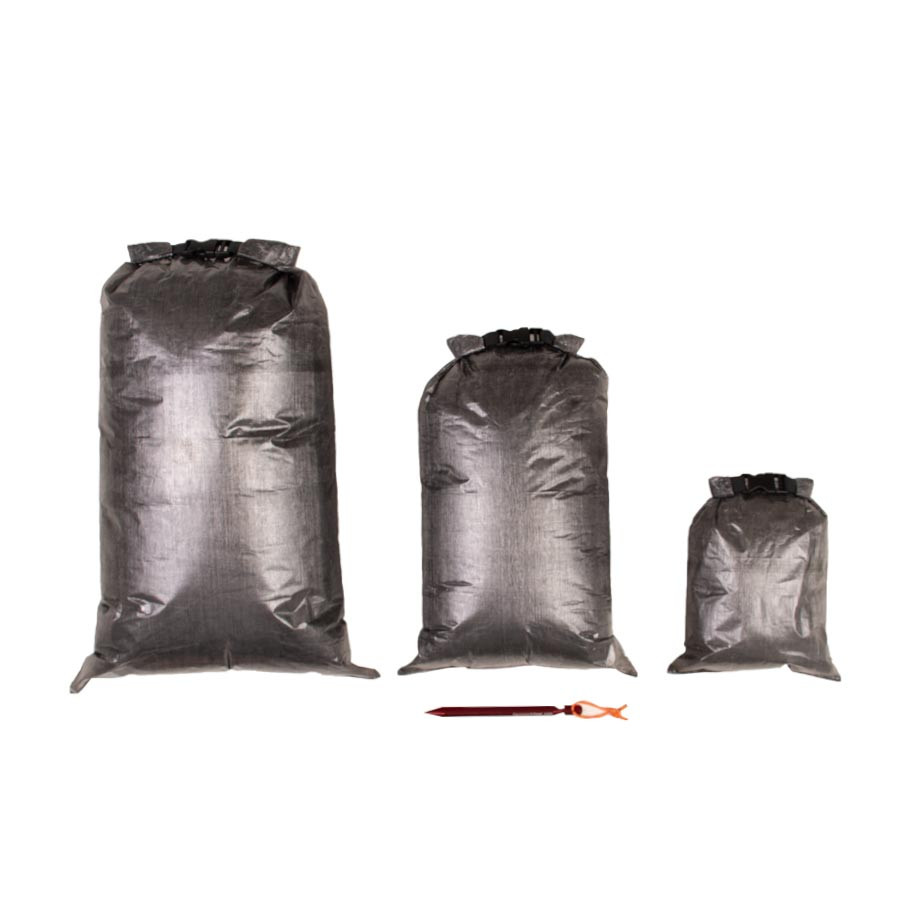
Overview
Hammock Gear’s Dyneema Fiber Dry Bag is a plain roll-top sack in three sizes. It’s sewn from 1.3 oz/yd² Dyneema Fiber (the material once sold as cuben fiber) and finished with fully taped seams. It’s aimed at backpackers who want a quilt, food bag or electronics kit kept dry for a few grams. The trade-off is that it’s rated for rain and damp, not for going underwater.
Key Specs
| Spec | Detail |
|---|---|
| Fabric | Dyneema Fiber, approx. 1.3 oz/yd² |
| Weight | 17.9–34.1 g depending on size |
| Capacity | ~2.2 L, ~8.5 L or ~14 L |
| Closure | Roll-top with grosgrain stiffener and ¾” backpack buckles |
| Seams | Fully taped |
| Water rating | High water-resistance; not rated for full submersion |
| Dimensions (flat) | Small 8 × 12 in; Medium 10.5 × 18 in; Large 13.5 × 23 in |
| Dimensions (rolled) | Small 5 × 7 in; Medium 7 × 14 in; Large 8 × 18 in |
| Price | $19–$45 depending on size |

Build your Gear Closet
View all of your gear in one place, create packing lists and hit the trail with confidence. Available on iOS, Android and the web.
Get StartedPerformance
Weather protection. Hammock Gear describes the bags as built for rainy or damp conditions, and says plainly that they aren’t meant to be dunked. That matches how owners use them. A Trailspace reviewer who carried a Medium on multiple multi-night trips used it to keep food dry while it hung overnight in the rain. The reviewer called the bag waterproof against everything short of full submersion. With a taped-seam body and a rolled top, the weak point on any bag like this is the closure. Rolling it tightly is the one thing the user has to get right.
Weight. Dyneema is the whole point here. The Small weighs 17.9 g, the Medium 25.9 g and the Large 34.1 g. For comparison, a Large that holds two quilts weighs about as much as a few sheets of paper. The fabric also doesn’t stretch and resists tearing, so the bag shouldn’t suffer from the snags and abrasions that wear down thinner coated nylon sacks.
Closure and handling. The roll-top uses a stiff grosgrain strip to hold a crisp fold, and ¾” backpack buckles to lock it. Owners say the roll compresses contents easily, which matters for a quilt going into a pack. The buckles are chunkier than the 3/8” hardware on some cottage-made DCF bags, and that adds a little weight, but it makes the bag easier to close with cold or wet hands. One buyer was surprised by an extra grosgrain loop around the top of the bag. It’s likely meant for hanging. The buckle is threaded through it, so it can’t be cut off without losing the closure.
Durability. Trailspace’s reviewer described the workmanship as excellent and said the bag held up over many nights out. Hammock Gear’s own site shows a 4.48 out of 5 average from 23 customer ratings. Buyers describe the bags as simple, robust and good value, and some have bought several to carry food and quilts. Dyneema Fiber is not a stuff-sack fabric that can be shoved around forever. Like all DCF it can wear along folds and crinkle over time, so a bag that rides loose inside a pack lasts longer than one strapped to the outside.
Where it fits. Hammock Gear’s suggested uses are practical. The Small suits first-aid kits, snacks or electronics. The Medium takes a quilt or clothing kit, and several days of food. The Large will hold two top quilts or a tarp and accessories.
Choosing a Version
The three sizes differ only in volume and length. Fabric, seams and closure are the same across the range.
- Small (~2.2 L, 17.9 g): For electronics, a first-aid kit, a phone and battery bank, or a day’s snacks. At this size, a standard zip bag does the job for less, but this one rolls shut and has a stiffener.
- Medium (~8.5 L, 25.9 g): The pick for most hikers. It holds a quilt or a puffy and clothing kit, or about several days of food, and it’s the size that owners most often describe using.
- Large (~14 L, 34.1 g): For a full sleep system, two top quilts, or a tarp plus accessories. It’s also a roomy bag for a winter-weight puffy or a bulky down jacket.
There’s no 10 L option. A hiker between sizes picks the Medium at 8.5 L or the Large at 14 L. Anyone with a bulky quilt should size up, since a bag that’s too small can’t be rolled enough to seal.
Pros & Cons
Pros
- Very light: 17.9–34.1 g across the range
- Taped seams and a rolled top keep out rain and damp
- Stiff grosgrain and ¾” buckles make the closure easy to use with cold hands
- Three practical sizes covering quilts, food and small kit
- Priced $19–$45, which is below many other DCF sacks
- Strong, non-stretch fabric with a good track record among owners
Cons
- Not rated for full submersion, so it’s a poor choice for packrafting or river crossings
- Buckle hardware adds bulk compared with minimal DIY bags
- Extra grosgrain loop on the top can’t be removed without losing the buckle
- No size between 8.5 L and 14 L
- DCF will crinkle and eventually wear at the folds
Who Should Buy This
Hammock Gear’s bags suit backpackers who want to waterproof a sleep system or food bag without adding more than an ounce. They fit hikers who already trust a pack liner but want a second layer of protection for a quilt. They’re a good buy for anyone replacing heavier silnylon or PVC dry sacks. Packrafters, canoeists and anyone who expects to drop a bag in water should look for a bag rated for submersion, and people who just need a stuff sack don’t need to pay Dyneema prices.
Verdict
This is a straightforward ultralight dry bag that does what it says: it keeps rain off a quilt or a bag of food, at 17.9–34.1 g and a fair price. The Medium is the best choice for most hikers. Skip it only if the bag will be going into water.