Gregory Zulu Review
Gregory's Zulu pairs a pivoting FreeFloat hipbelt and trampoline mesh back with a U-zip front panel, in 40L and 55L sizes. It's comfortable, but heavy for ultralighters.
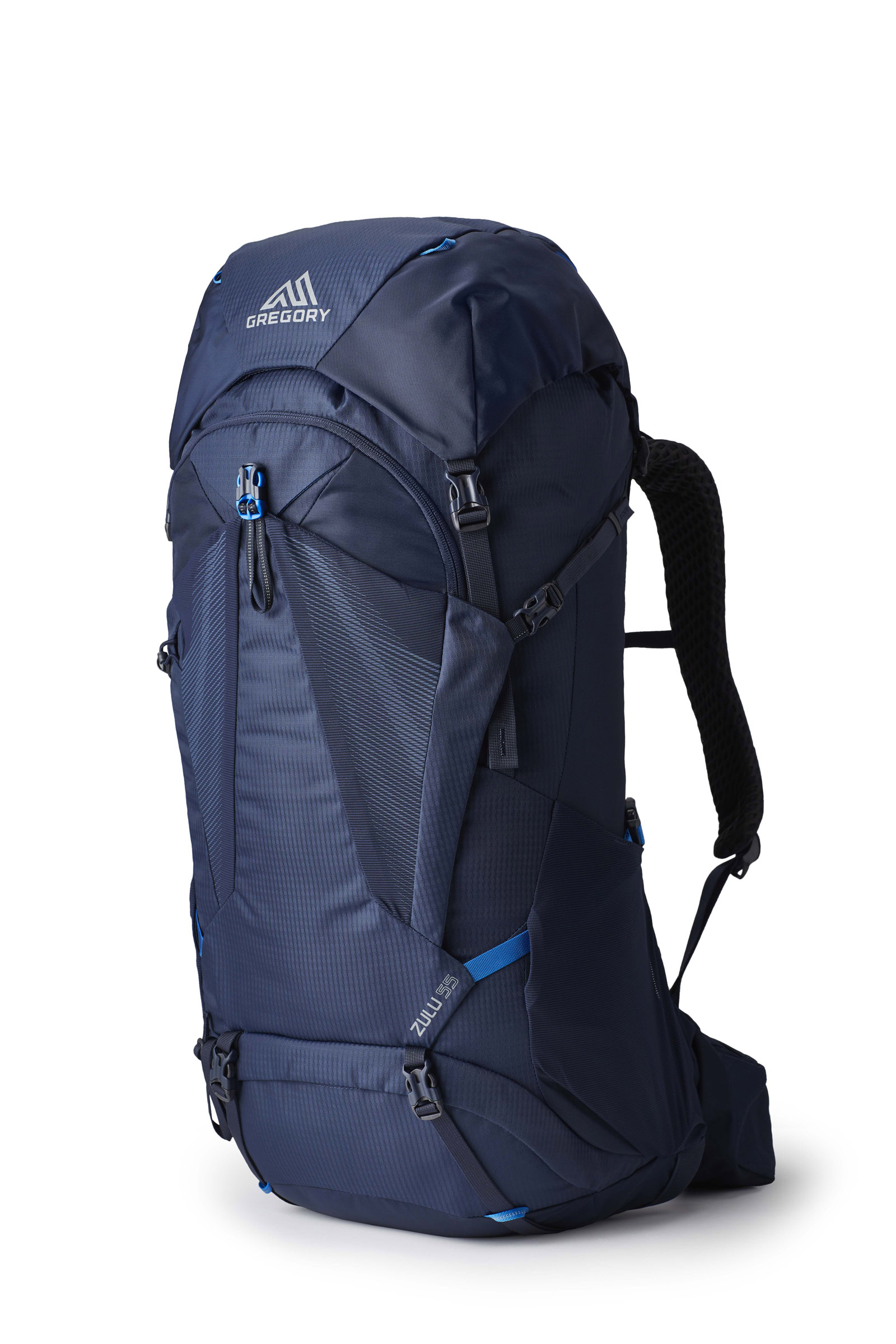
Overview
The Gregory Zulu is a ventilated, adjustable-torso backpack built around a hipbelt that pivots with the hiker’s stride. It comes in two capacities: a 40L aimed at fast overnights and big day hikes, and a 55L for loads heavy enough to justify a real frame. The trade-off is the same in both: the Zulu buys comfort, features and durability with grams, and ultralight hikers will find lighter options.
Key Specs
| Spec | Detail |
|---|---|
| Weight | 1,330–1,910 g depending on capacity |
| Capacity | 40L or 55L (the 55 is 55L in M/L and 53L in S/M) |
| Torso adjustment | 3.5 in |
| Torso fit range (55) | S/M: 15–19 in; M/L: 18–22 in |
| Suspension | FreeFloat dynamic hipbelt with tensioned mesh back panel |
| Frame | Perimeter spring steel with fiberglass anti-barreling cross-stay |
| Access | Top, front U-zip; sleeping bag compartment on the 55 |
| Rain cover | Included |
| Reservoir compatible | Yes |
| Sizes | S/M, M/L |
| Warranty | Limited lifetime |
Versions compared
| Image | Version | Weight | vs. lightest |
|---|---|---|---|
 | 40 | 1330 g (46.9 oz) | lightest |
| 55 | 1910 g (67.4 oz) | +580 g |

Build your Gear Closet
View all of your gear in one place, create packing lists and hit the trail with confidence. Available on iOS, Android and the web.
Get StartedPerformance
Suspension and fit
The FreeFloat hipbelt is the reason to consider this pack. Instead of bolting the belt rigidly to the frame, Gregory connects them with flex panels at the lower back, so the belt can pivot as the hiker’s hips rotate. Padding is 3D-shaped to wrap the hips. The effect is most noticeable on uneven ground, where the load rocks less against the body than it does on a fixed belt.
Expectations should be calibrated. Reviewers note the pivot is effective at damping side-to-side sway, though it isn’t the equal of the mechanical rotating hipbelts on pricier packs, which are also often heavier at comparable capacity. For three-season loads in the 25–35 lb range, the movement reads as natural rather than intrusive.
Torso length adjusts continuously, marked in one-inch increments. The 55’s hipbelt spans 27–46 in on the S/M and 29–51 in on the M/L. With only two shells, hikers near a size boundary should try both. One 40L owner with a 31-inch waist, wearing the larger size, ran out of strap length trying to cinch the belt tight, and the belts can’t be swapped.
Ventilation
A full-length tensioned mesh panel holds the pack off the back, and the gap is meaningful on hot climbs. It isn’t the most breathable suspension in the category, and hikers in high humidity will still sweat. Against Osprey’s AntiGravity packs, the Zulu’s ventilation cavity is less intrusive: it doesn’t pull the load backward or eat into the main compartment, and the pack is substantially lighter.
Load hauling
Here the two capacities diverge.
The 55 carried loads of about 30 lb comfortably over days of 12 miles or more. Testers also found it comfortable close to its recommended ceiling of 40 lb, and one user reported a 41 lb load, 12 lb of it food and water, without trouble.
The 40 is rated to about 35 lb, and owners are more conservative: 15–20 lb is the range where reviewers describe it as stable and reasonably comfortable, a good match for the lighter gear lists the pack is meant for.
Access and organization
Both packs open through the top drawstring and a front U-zip panel that gives near-suitcase access to the main compartment. This is the Zulu’s most useful feature at camp. Both have zippered hipbelt pockets, a stretch-mesh front pocket large enough for a rain jacket, a zippered lid pocket, and an internal reservoir sleeve. The 40 will hold a 2L reservoir or a tablet in that sleeve, but not both.
The 55 adds a bottom sleeping bag compartment and a floating lid, and its stretch side pockets swallow a liter bottle and can be reached on the move, although reaching a wide-mouth bottle gets tricky when the pack is stuffed. The 40’s side pockets are less friendly: compression straps cross them, and owners say bottles are hard to retrieve and replace with the pack on. Reviewers also call the front of the 40 fussy, with the front panel, U-zip and rain-cover pocket layered on top of one another. On both, the rain cover shares an internal pocket with a key clip.
On the 55, a Bear Vault BV500 fits horizontally in the main compartment but crowds out the side pockets. A BV475 is the better match.
Durability
Construction is typical Gregory. The body uses 210-denier nylon and high-tenacity nylon, with a heavier-duty double-layer base on the 55 (630-denier) and a 420-denier base on the 40. The current fabrics are recycled, PFC-free polyester. A handful of owners report back mesh stretching after extended heavy use, though it hasn’t shown up as a widespread failure.
Choosing a Version
Zulu 40 (1,330 g). A fast overnight or two- to three-night pack for hikers carrying 15–20 lb, or a big-day pack with room for a layer and lunch for two. Owners who weighed it found it came in heavier than Gregory’s listed figure, so budget for a little more than the spec sheet. The awkward side pockets are the main irritation.
Zulu 55 (1,910 g). The one for trips up to about five days, bulkier sleep systems, a bear canister, or group gear. The 580 g gain over the 40 buys a sleeping bag compartment, better side pockets, a sturdier base and a frame that stays comfortable near 40 lb. Hikers who regularly carry more than 25 lb should start here.
Pros & Cons
Pros
- FreeFloat hipbelt moves with the hiker and reduces fatigue on uneven terrain
- U-zip front access makes camp organization easy
- Wide torso and hipbelt adjustment across two sizes
- Roomy hipbelt pockets that take a modern smartphone
- Rain cover included
- Durable fabrics and a limited lifetime warranty
Cons
- Heavy for the volume; lighter packs offer more liters per gram
- Only two size shells, and small waists on the larger size may run out of belt
- Side pockets are awkward with the pack on, especially on the 40
- Back mesh can loosen after heavy, repeated use
- Rain cover shares a crowded internal pocket
Who Should Buy This
The Zulu suits hikers carrying 25–40 lb (55L) or 15–25 lb (40L) who want a ventilated, forgiving carry and don’t mind paying in ounces. It’s a sensible first real backpacking pack and a good fit for weekend-to-five-day three-season trips with a full kit. Hikers with a base weight under 15–20 lb, or anyone counting grams on a long thru-hike, should look at a frameless or lightweight framed pack instead.
Verdict
The Zulu is a comfortable, well-built pack whose hipbelt delivers on its promise, and whose biggest flaw is mass. Pick the 55 for loaded multi-day trips and the 40 for short overnights, and look elsewhere if every ounce counts.