Lowa Renegade Evo GTX Mid Review
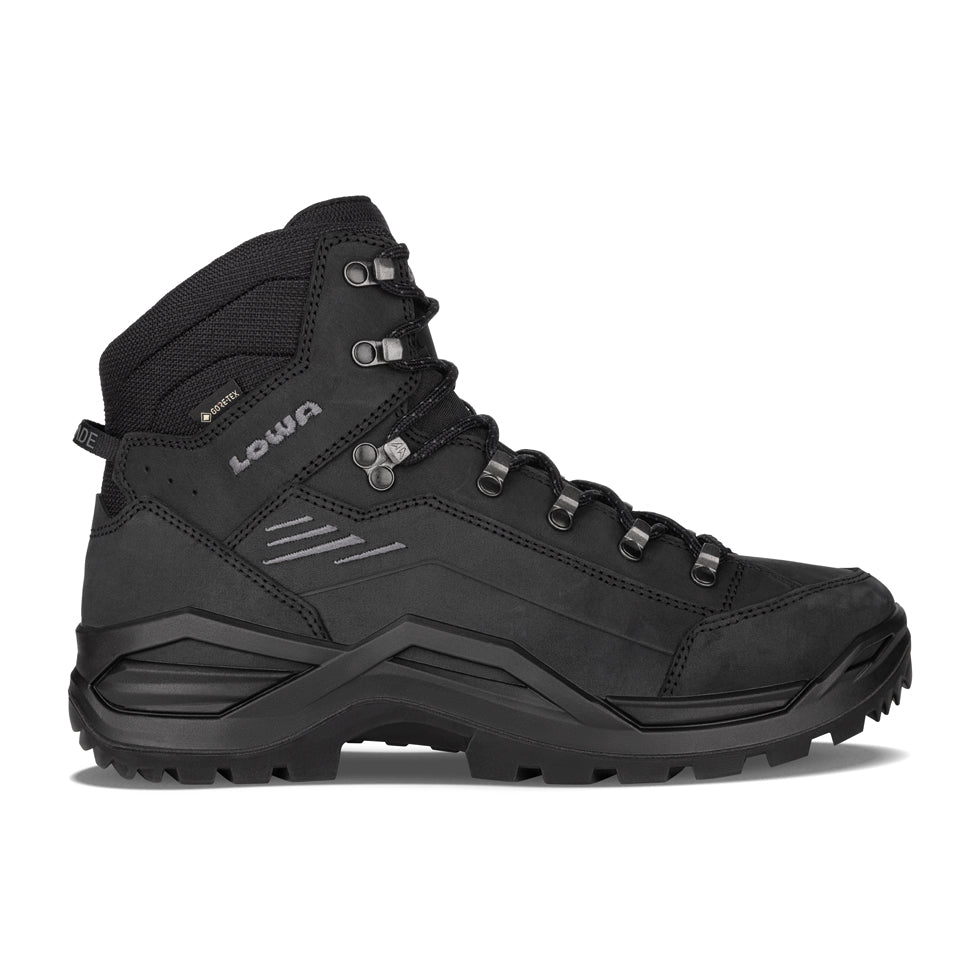
Lowa's Renegade Evo GTX Mid is a stable, durable leather boot with Gore-Tex and Vibram traction, but it weighs 1,179 g a pair and costs $280.
Overview
The Renegade has been in Lowa’s catalog in one form or another for roughly 25 years. The Evo version keeps the formula: a nubuck leather upper, a Gore-Tex liner, a Vibram outsole and a tall, supportive cuff. It is a boot for hikers who want protection and stability on rough ground, particularly under a heavy pack. The price of that security is weight, and ultralight hikers will feel it.
Key Specs
| Spec | Detail |
|---|---|
| Weight (pair) | 1,179 g (2 lb 9.6 oz) |
| Upper | Nubuck leather |
| Waterproofing | Gore-Tex lining |
| Outsole | Vibram Evo |
| Midsole | Dual-density DuraPU / DynaPU, with PU heel support |
| Cut | Mid |
| Price | $280 |
| Sizing | Men’s 7.5–15 and women’s 5–11, in narrow, regular and wide widths |

Build your Gear Closet
View all of your gear in one place, create packing lists and hit the trail with confidence. Available on iOS, Android and the web.
Get StartedPerformance
Stability and support. Stability is the Renegade’s strongest trait. SectionHiker’s review singles it out as the boot’s defining characteristic, crediting strong heel and arch support. Outdoor Gear Lab testers rated the ankle support very good and the overall stability top-tier. Better Trail’s testers, who logged hundreds of miles across multiple pairs, scored it 4 out of 5 for support and stability and praised its torsional rigidity. Gear Junkie’s reviewer found the ankle support especially useful when scrambling. Over snow, rock, gravel and roots in the Eastern Sierra, the boot handled each surface without complaint.
Midsole and comfort. The double-injection midsole puts a firmer support layer over a softer cushion, and a PU wrap cups the heel. The result is firm and well isolated from the trail. It is noticeably stiffer than plush boots like the Hoka Kaha 3 GTX, Better Trail notes. Switchback Travel found the midsole isolated well even under a loaded pack on rock scrambles. Outdoor Gear Lab suggests the boot could use a little more cushion. Break-in varies. Hikers used to leather boots report that the Renegade molds to the foot within a few outings, while Outdoor Gear Lab’s women’s-model testers called it among the stiffest boots they tried and said it took many miles to soften. One Better Trail tester wore the boots for long days on a month-long trip to Norway’s Lofoten Islands without trouble.
Traction. The Vibram Evo outsole has aggressive lugs, and reviewers at SectionHiker and Switchback Travel both describe the grip as excellent. Better Trail scored traction 4 out of 5 and called it dependable on most surfaces. Gear Junkie scored traction 7 out of 10.
Weather protection and breathability. The Gore-Tex liner kept testers’ feet dry. Outdoor Gear Lab’s women’s-model testers measured a flood height of almost 6 inches and saw water bead off the treated nubuck. Better Trail called the waterproofing top-of-the-line. The cost is breathability. Outdoor Gear Lab says the boots are not the best for hot-weather hiking, and Better Trail describes breathability as middling. In wet, cold or shoulder-season conditions, that works in the boot’s favor. On a July ridge walk, feet will run warm.
Durability. Durability is a headline selling point. Better Trail rated it 4.5 out of 5, and Outdoor Gear Lab counts the leather upper among the most durable it has tested. Switchback Travel was less impressed, saying build quality could be better at this price.
Fit. Reviewers disagree on sizing. Outdoor Gear Lab’s men’s-model testers found the boot fits slightly short. Its women’s-model testers found the fit true to size and suited to narrower feet, and suggested sizing up for toe room or if between sizes. SectionHiker advises leaving enough toe room for descents, when feet slide forward. The range of widths helps hikers who struggle to find a fit. The lacing is easy to adjust, and a wide-opening tongue and a rear pull loop make the boot easy to get on, though some find the square metal lacing hooks slightly uncomfortable to grip.
Weight. At 1,179 g a pair, this is a conventional leather boot, not a lightweight one. SectionHiker names weight as its main weakness. Gear Junkie says minimalist hikers should look elsewhere, though it adds that the Renegade feels robust without feeling like bricks on the feet. For its category it is on the lighter side.
Pros & Cons
Pros
- Excellent stability, with strong heel, arch and ankle support
- Dependable Vibram traction on mixed terrain
- Gore-Tex waterproofing with a tall flood height
- Durable nubuck leather upper
- Narrow, regular and wide widths in a broad size range
- Firm midsole that isolates the foot well under load
Cons
- 1,179 g a pair, far heavier than trail runners
- Stiff and slow to break in for some hikers
- Warm in hot weather
- Fit can run short in some sizes
- $280, with one reviewer questioning build quality at that price
Who Should Buy This
The Renegade suits backpackers and hikers who carry heavy loads or travel off-trail, hike in cold or wet weather, or simply prefer the protection of a leather mid-cut boot. It also suits anyone who wants one boot to last many seasons. Thru-hikers and ultralight backpackers with base weights low enough to run in trail shoes should look elsewhere. The same goes for hot-climate hikers and anyone who wants a soft, flexible, quick-drying shoe.
Verdict
The Renegade Evo GTX Mid does what a classic leather boot should: it supports the foot, sheds water and lasts. It is a poor fit for the ultralight philosophy, but it is among the better options for loaded, rough-country trips. Buy it if stability and durability matter more to you than ounces.