Exped Camp Slipper Review
Exped's insulated Camp Slipper weighs 136–156 g and swaps a boot-sweaty evening for warm, grippy feet, but its thin sole and loose fit limit it to camp duty.
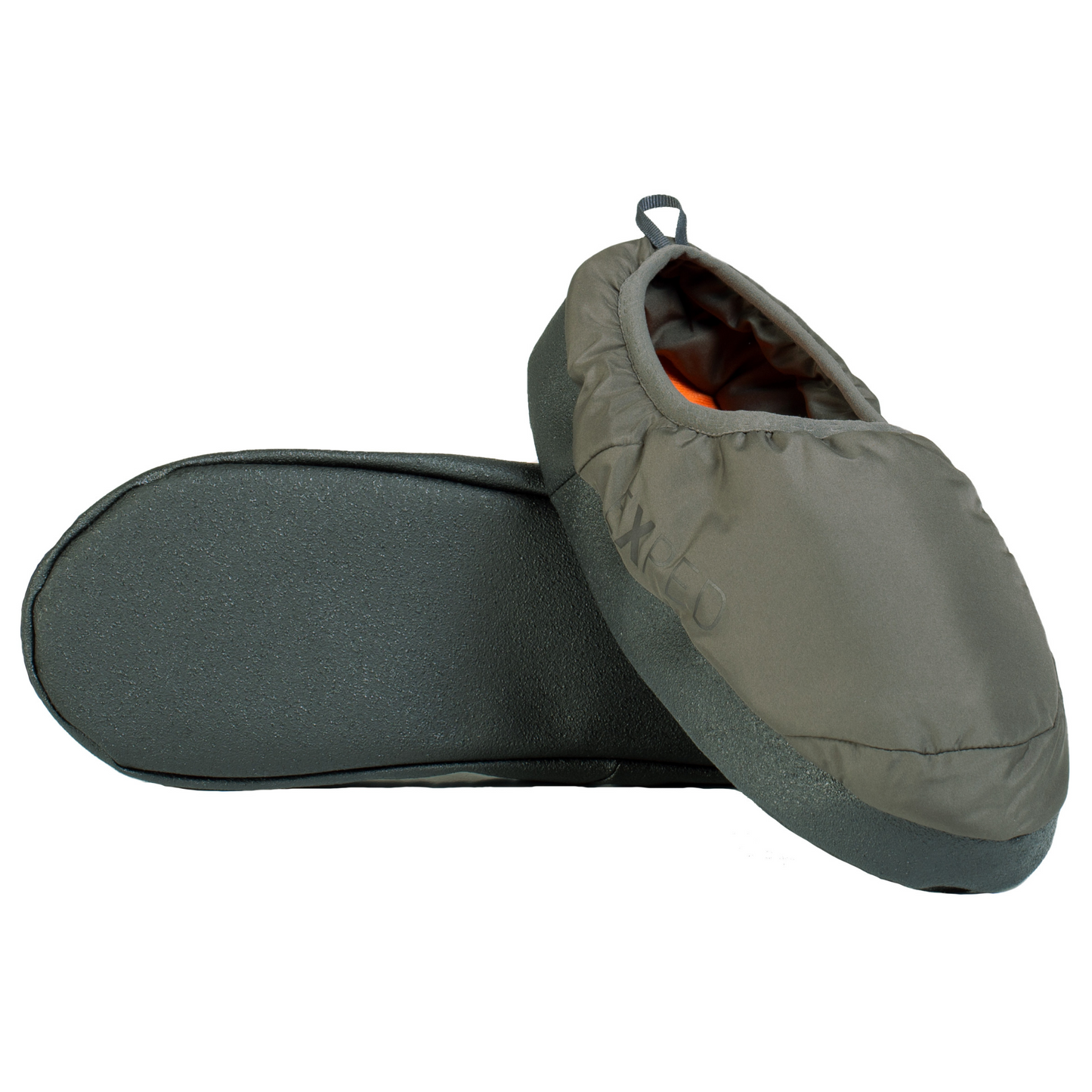
Overview
The Exped Camp Slipper is a thin, synthetic-insulated bootie with a rubberized TPU sole, built for the hour between taking off wet trail shoes and zipping into a sleeping bag. It suits cold-footed hikers, winter campers and hut users who want something warmer than a sandal and more durable than a down sock. The trade-off is plain: it is warm and light, but the sole is barely 4 mm thick and the fit runs roomy, so it is a camp shoe in the narrowest sense.
Key Specs
| Spec | Detail |
|---|---|
| Weight | 136–156 g depending on size |
| Shell | 50D recycled polyester (OEKO-TEX 100, PFC-free) |
| Insulation | 100% recycled synthetic polyester |
| Insole | 4 mm EVA foam |
| Outsole | 420D recycled TPU, anti-slip, PVC-free |
| Closure | Pull-on with integrated elastic ankle strap |
| Extras | Attachment loop; machine washable at 30°C per owner reports |
| Sizes | S, M, L, XL (unisex) |
| Retail price | Roughly $55–60 USD |
Versions compared
| Image | Version | Weight | vs. lightest |
|---|---|---|---|
| Standard | 136 g (4.8 oz) | lightest |
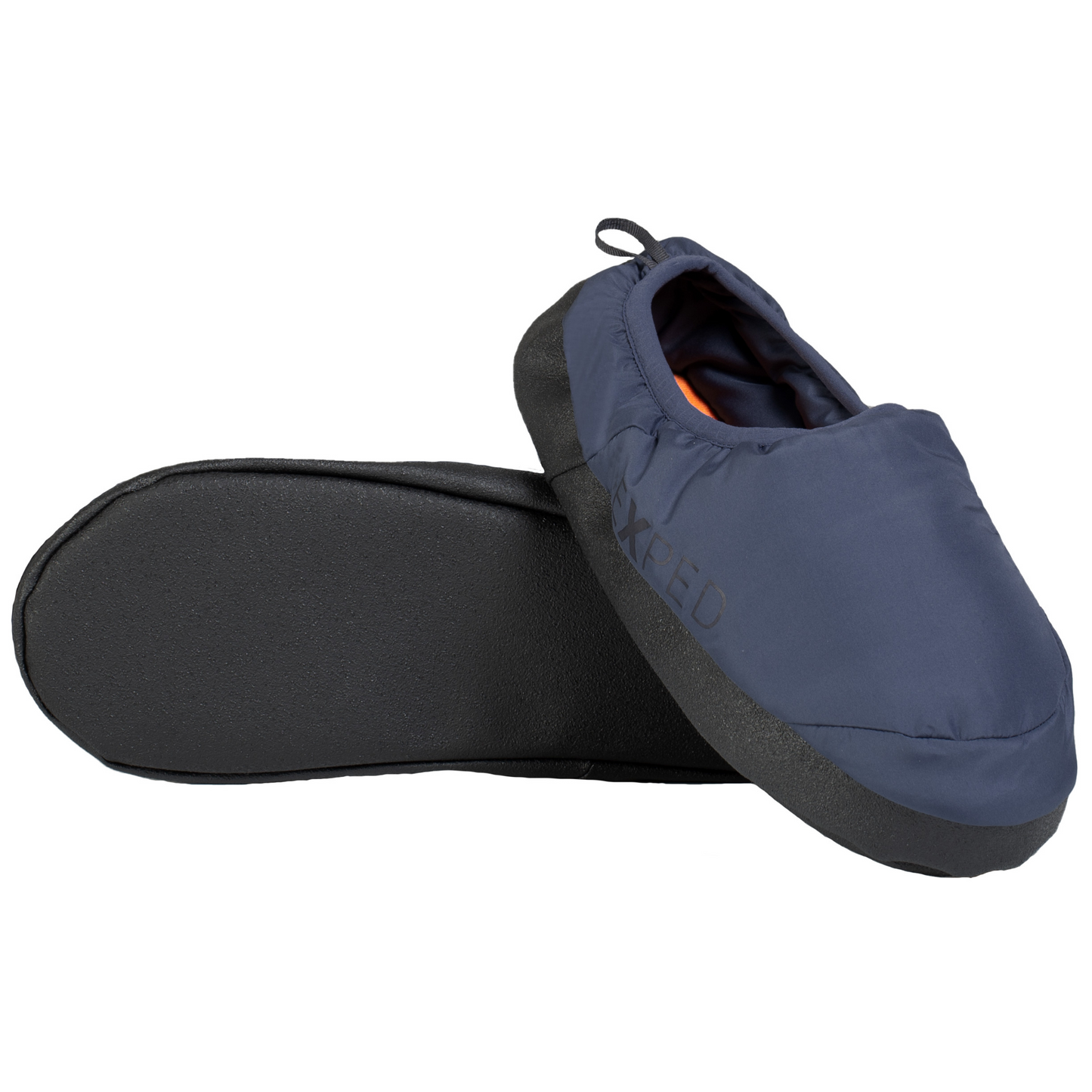 | Large | 156 g (5.5 oz) | +20 g |

Build your Gear Closet
View all of your gear in one place, create packing lists and hit the trail with confidence. Available on iOS, Android and the web.
Get StartedPerformance
Warmth. The insulation is deliberately modest. Testers who compared it with down booties note it does not reach that level of loft, but the combination of synthetic fill, a closed-cell EVA footbed and an elastic ankle strap takes the chill off frozen grass and rock. Trek Scotland’s winter testers described the insulation as light but sufficient, and a Rokslide user summed up the comparison that matters: far warmer than a flip-flop or Croc. REI buyers, who rate the slipper 3.7 out of 5 across 35 reviews, repeatedly describe it as warmer than its thinness suggests. Synthetic fill also dries quickly, which counts for something when the alternative is a damp down bootie.
Traction and sole. The TPU outsole is the standout feature. One reviewer wore it through two ice storms without a fall and called the grip better than expected, though not at the level of a Vibram boot sole. Trek Scotland found it secure on Cairngorms granite but less stable on grass and wet vegetation. The same textured surface catches on sleeping bag fabric, so the slipper is better left at the tent door than worn inside the quilt.
Underfoot comfort. This is where the slipper shows its weight savings. The sole is thin enough to roll up for packing, which means rocks and roots register through it. Pack & Trail’s reviewer found tent pads, huts, leaves and smooth ground comfortable, but not much beyond that. An REI customer made the same point: the slipper is for the campfire, the pier and the porch, not a stroll.
Water resistance. Opinions are split. Pack & Trail rated the sole very water resistant, and an REI reviewer stayed dry through dewy grass. Outdoor Prolink’s tester, however, flagged the low rand and the stitched seam where the rubber meets the fabric as weak points and docked the slipper to 3.5 out of 5. The sensible reading: damp evening grass is fine, puddles and wet snow are not.
Fit and packability. Sizing is the most common complaint. Pack & Trail’s reviewer said a Large on a size 10 foot fit very large, Trek Scotland’s testers found the Large loose at EU 43 and suggested sizing down for a snug fit, and an REI buyer reported the foot sliding forward and jamming the toes while walking. Exped’s own size chart puts the Large at US men’s 10–11, with a foot length of 11.6 in. The slippers fold or stuff into a pack corner easily, and the attachment loop lets them hang from the outside of a pack. Trek Scotland’s testers removed the supplied elastic bands to save a few grams, which is the kind of fussiness this product attracts.
Choosing a Version
The Standard (Medium) and Large differ only in size, not in construction. Exped’s chart puts the Standard at US men’s 7–9 (women’s 8.5–10.5) with a 10.8 in foot length, and the Large at US men’s 10–11 (women’s 11–13) with an 11.6 in foot length. The Large adds 20 g. Small (120 g) and XL (170 g) fill out the range.
Owners consistently report generous cuts, so anyone at the bottom of a size bracket, or anyone who wants a snug, secure feel for walking to the privy, should consider the smaller size. Those who wear thick socks or want room to wiggle toes in cold conditions will be happy at the top of the range.
Pros & Cons
Pros
- 136 g in Standard and 156 g in Large, light enough to justify a carry
- Noticeably warmer than sandals or clogs, with quick-drying synthetic fill
- Grippy TPU sole handles rock, ice and hut floors well
- Packs small, with a loop for external carry
- Recycled, PFC-free and PVC-free materials, and washable
Cons
- Thin sole transmits rocks and roots
- Fit runs large, and the foot can slide forward when walking
- Water resistance is inconsistent, with a low rand and a stitched seam
- Sole grip is poor on wet grass and snags sleeping bag fabric
- Not as warm as a down bootie, and priced at $55–60
Who Should Buy This
Cold-footed three-season and winter campers, hut-to-hut hikers and climbers who want a warm, compact bootie for tent and camp chores will get the most from it. Hikers who need a camp shoe to cover wet ground, midnight bathroom trips across a field or real walking should choose a foam clog or sandal. Hikers who want maximum warmth per gram in a sleeping bag should look at down booties instead.
Verdict
The Camp Slipper does the job it was designed for: warm, grippy, light and compact. It falls short on sole thickness, fit precision and wet-weather protection, which is why owners rate it solidly rather than enthusiastically. It earns a place in the pack of anyone who gets cold feet at camp, and nowhere else.