Summit to Eat Beef and Potato Stew Review
A budget-friendly freeze-dried trail meal with real veggie content, but chewy beef and potato hold it back from the top tier.
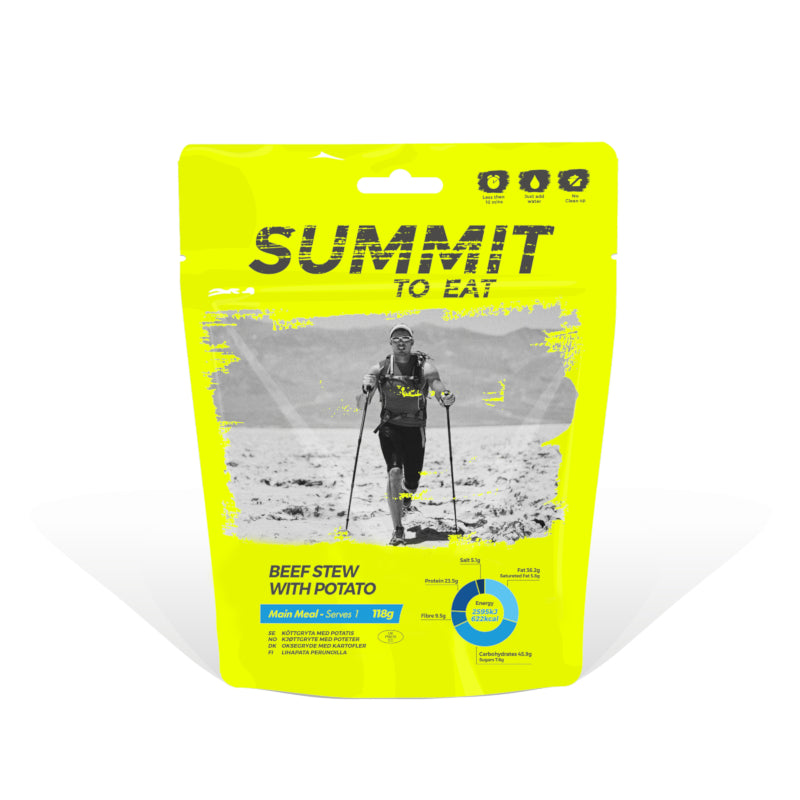
Overview
Summit to Eat’s Beef and Potato Stew is a freeze-dried backpacking meal from the UK brand that’s produced by European Freeze Dry — the same outfit behind Mountain House’s European lineup. It’s aimed at hikers, bikepackers, and DofE-style expedition crowds who want a calorie-dense, no-fuss dinner without paying premium prices for it.
Key Specs
| Spec | Value |
|---|---|
| Weight (dry, single serving) | 118 g |
| Big Pack weight (dry) | 190 g |
| Calories (single serving) | 624 kcal |
| Calories (Big Pack) | 1,005 kcal |
| Water required | 300 ml |
| Servings | 1 (per standard pouch) |
| Shelf life | 7 years |
| Main ingredients | Diced potatoes, beef strips, carrots, green beans, onion, tomato puree |

Build your Gear Closet
View all of your gear in one place, create packing lists and hit the trail with confidence. Available on iOS, Android and the web.
Get StartedPerformance
Rehydration & texture. This is where the meal splits opinion. The Summit to Eat Beef and Potato Stew took about a minute longer to rehydrate acceptably than the advised eight minutes, and even when hydrated the potato chunks came out rather chewy. The small beef strips remained very chewy for as long as it took to eat the meal, and the rest of the ingredients were rather mushy without much texture. That’s a fairly consistent complaint across independent testers — freeze-dried beef strips are notoriously hard to rehydrate fully in a bag, and this one doesn’t buck the trend. If you’re picky about texture, try adding an extra splash of water and giving it 12-15 minutes in a cozy rather than sticking to the printed 8-minute window.
Interestingly, official prep instructions aren’t fully consistent between retailers — some list 300 ml of water, others 360 ml — so a bit of experimentation on your first trial run at home (not on trail night one) is worth doing.
Flavor. Here the meal fares better. One reviewer found the beef stew tasted great, with good flavors and texture in her side-by-side test of Summit to Eat’s range, and a UK gear tester similarly noted the meal had great taste, plenty of veg, and was really warming after a cold day out walking. On the ingredient side, you’re getting real diced vegetables rather than TVP filler — diced potatoes, cooked beef strips, diced carrots, green beans, diced onion, rapeseed oil, and tomato puree make up the bulk of the pouch, in a tomato-based gravy rather than a thick brown stew base.
Calorie density and portioning. At 624 kcal for 118 g, this lands in solid mid-pack territory for freeze-dried meals — not as calorie-dense as some 700+ kcal offerings, but respectable for a single-serve pouch. The Big Pack option (190 g / 1,005 kcal) is worth considering if you’re hiking hard; the Big Pack is best suited for two people who aren’t super hungry, though a genuinely hungry hiker can happily eat it solo.
Packability and practicality. The pouch itself scores well on convenience — it packs down small and scrunches into awkwardly shaped gaps, which matters if you’re stuffing food into a framebag or the odd corners of a pack. There are handy markers on the inside of the packet for measuring water if you’re boiling a batch for multiple meals, and the seal works well too, so you don’t have to worry about it re-opening in your pack.
Value. This is the strongest selling point. Even testers who weren’t thrilled with the eating experience noted that Summit to Eat is still worth considering as an affordable option, with value up there among the best tested — meaning it’s relatively painless on your wallet if you’re stocking up for a longer trip. Compared to premium US brands, Summit to Eat typically undercuts on price while still landing in a similar calorie range.
Pros & Cons
Pros:
- Genuinely affordable relative to competing freeze-dried meals — good for stocking a multi-week resupply box
- Real diced vegetables, not just reconstituted flakes
- Tomato-based gravy has decent, warming flavor that several testers enjoyed
- Packs down small and squishes into odd pack spaces easily
- Reliable pouch seal, with built-in water-level markers
- 7-year shelf life makes it viable for emergency/backup stock too
Cons:
- Beef strips and potato chunks stay noticeably chewy even after extended rehydration time
- Printed water amounts are inconsistent across sources (300 ml vs. 360 ml) — expect some trial and error
- Texture overall skews mushy/inconsistent rather than distinct bite
- Not the most calorie-dense option per gram if you’re optimizing strictly for weight-to-calorie ratio
Who Should Buy This
This is a solid pick for budget-conscious backpackers, DofE/scouting groups, or anyone building a bulk resupply stash where price per meal matters more than five-star texture. It’s also a reasonable emergency-food stockpile option given the 7-year shelf life. If you’re an ultralight purist who eats the same three dinners on rotation and cares deeply about mouthfeel, the chewy beef and potato may grate on you after a few uses — in that case, it’s worth cross-shopping against other European freeze-dried brands or the standard Mountain House US lineup.
Verdict
The Summit to Eat Beef and Potato Stew won’t win any texture awards — the beef and potato chunks stay stubbornly chewy no matter how long you let them sit — but the flavor is decent and the price-to-calorie ratio is genuinely good. I’d rate it a 6.5/10: a dependable, budget-friendly pantry filler rather than a meal you’ll crave on trail.