SOTO Amicus Stove with Stealth Igniter Review
Packstack is reader-supported. When you buy through links on our site, we may earn an affiliate commission. This does not affect the independence or objectivity of our reviews.
The SOTO Amicus with Stealth Igniter is a 81g, wind-resistant canister stove offering strong build quality, reliable ignition, and genuine simmer control at an accessible price point.
Overview
The SOTO Amicus with Stealth Igniter (OD-1NVE) is a compact upright canister stove from Japanese manufacturer SOTO — a brand that has quietly become one of the most respected names in backpacking stoves. When the Amicus was released in 2015, it became SOTO’s first high-tech compact stove to rival the likes of the MSR PocketRocket and the Snow Peak Giga Power. At 81g with the igniter, it’s aimed squarely at 3-season backpackers, thru-hikers, and anyone who wants solid canister-stove performance without paying premium prices for a Windmaster. It earned Outdoor Gear Lab’s “Best Buy” award in 2022 — and based on what I’ve found across extensive real-world user reports, that designation still holds up.
Key Specs
| Spec | Value |
|---|---|
| Model | OD-1NVE |
| Weight | 81g (2.9 oz) |
| Output | 10,210 BTU / 2,800 kcal/h |
| Burn Time | ~1.5 hrs with 250g canister |
| Dimensions (in use) | 3.0 × 4.0 × 3.4 in (7.6 × 10.0 × 8.6 cm) |
| Dimensions (stowed) | 1.7 × 1.6 × 3.0 in (4.3 × 4.0 × 7.5 cm) |
| Fuel Compatibility | Standard isobutane Lindal valve (Primus, Snow Peak, MSR, Jetboil) |
| Valve System | Triple O-ring (non-regulated) |
| Igniter | Integrated piezo (Stealth — runs inside burner post) |
Would the Amicus Stove with Stealth Igniter earn its spot in your pack?
81 g · 2.9 ozAdd the SOTO Amicus Stove with Stealth Igniter to your gear closet and see exactly what it does to your base weight — then build your next packing list around it. Free, in about two minutes.
Free · No credit card · iOS & Android · Trusted by 3,000+ backpackers
Performance
Wind Resistance
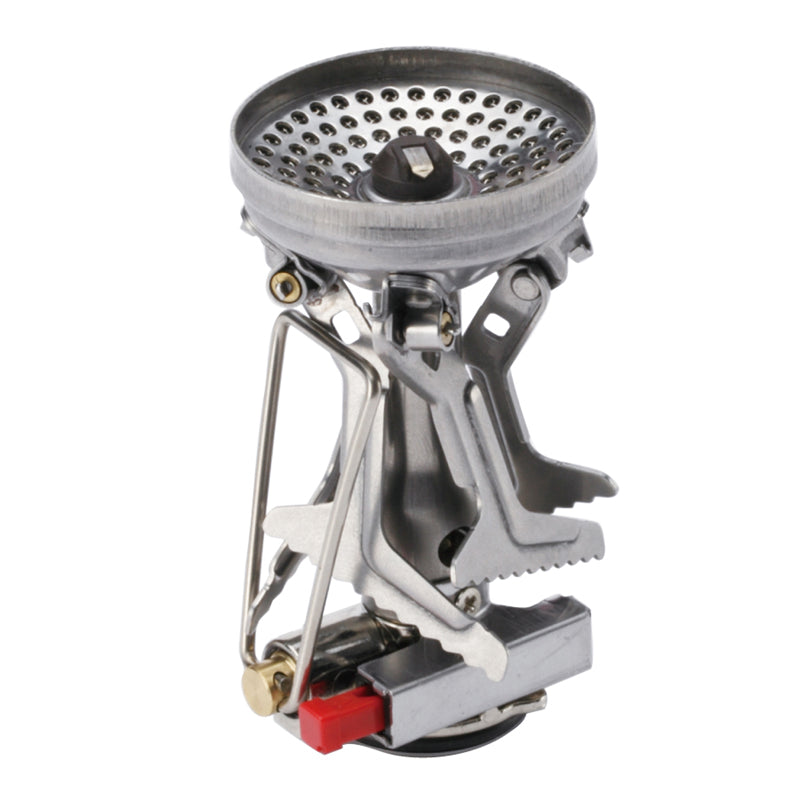
This is the Amicus’s main calling card in its price class. A unique raised ledge at the crown of the burner head, combined with a concave burner surface, is designed for increased performance under windy conditions. In practice, that design works — up to a point. In both lab and field testing, the Amicus performed well in friendlier wind conditions, with about a 20% reduction in fuel efficiency and a slight increase in boil times — but it completely blew out with moderate to strong gusts, especially at lower flame settings for simmering. So: better than most stoves at this weight and price, but not in the same league as a windscreen-integrated system like the Windmaster or Jetboil. In calm-to-breezy conditions, the concave burner does real work. In a proper gust, you’ll want to find shelter for the stove or step up to the Windmaster.
Also worth noting: this stove uses a Triple O-ring valve system that’s non-regulated. Unlike SOTO’s pricier Windmaster — which includes a micro-regulator for steadier output as the canister gets cold or depletes — the Amicus will lose pressure and output in sub-freezing temperatures and as your canister runs low. If you’re doing winter camping or high-altitude trips where temperatures routinely drop below freezing, keep that limitation in mind.
Boil Time & Fuel Efficiency
In standard conditions, it takes approximately 3.5 minutes to boil 1 liter of water using the Amicus.
The Amicus didn’t top the charts in fuel efficiency, performing similarly to other lightweight canister stoves with limited heat retention from burner to pot — though it offers great simmering if you want to make more involved meals in the backcountry.
One OGL tester found
the Amicus uses an average of 0.28 oz of fuel per boil.
For solo 3-season use, that’s perfectly reasonable — one 100g canister typically covers 2–3 days of cooking without drama.
Simmer Control
This is genuinely one of the Amicus’s strengths. The wire fuel valve is long enough that you can reach it without scalding your hands, should your pot boil over. The valve operation is smooth and adjusts steadily and slowly, so it’s possible to obtain a huge range of temperatures, from barely lit to roaring hot. For a stove at this price point, that level of flame precision is not a given — the Amicus delivers here where many competitors don’t.
The Stealth Igniter
SOTO’s igniter design is legitimately clever. Like the Windmaster, the igniter in the Amicus runs through the center post of the stove, protecting it from impact and creating reliable lighting performance. The Amicus ignites on first or second strike max, and consistently — the igniter wire and spark run inside the canister, which is neat and helps with durability.
That said, the igniter is not immortal. Multiple users have reported it eventually failing with extended use. One long-term user reported the igniter gave up after a fair number of uses — something she speculates is where SOTO passes savings on to the customer. Notably, this doesn’t appear to be an isolated incident, and a spare piezo can be purchased to replace the broken one for around €10. Always carry a lighter. The igniter is a convenience, not a guarantee.
Pot Stability & Build Quality
The pot stabilizers rotate on a spring rivet and secure with a small metal tab and hook. Once in place, these feel secure, though the Amicus isn’t the most sturdy option for larger pots of water or food.
The four-arm design (most competitors use three) does give you a meaningful stability edge —
one user specifically chose the Amicus over the Windmaster because it has a functional, 4-arm integrated foldable support that won’t get lost or forgotten.
For a 750ml–1L pot, stability is a non-issue. For a 2L pot or a wider pan, you’ll notice the short arm length and start to feel less confident.
A 1-liter cookpot is the more fitting setup for this stove.
Overall build quality punches above its price. The stove feels durable despite its thin arms — and after multiple hikes with rough handling, it shows no signs of wear or damage. It feels flimsy and small, but having used it in different conditions, it will last for many adventures to come.
Pros & Cons
Pros
- Genuine wind resistance from the concave/raised-ledge burner design — meaningfully better than flat-burner competitors
- Four spring-loaded pot supports (vs. three on most rivals) for better stability and fewer “lost parts” headaches
- Smooth, wide-range simmer control via the long valve wire
- Stealth igniter is cleverly routed through the post for shock resistance — and is user-replaceable
- At 81g, it’s light enough to forget about in your kit
- Stows small enough to nest inside a 750ml pot
- Compatible with any standard Lindal valve isobutane canister
- Price-to-performance ratio is hard to beat in this category
Cons
- No micro-regulator: expect degraded output in cold temps and with low canisters
- Igniter can fail prematurely with heavy use — carry a backup lighter, full stop
- Pot supports are on the short side; less confidence with 1.5L+ pots
- Will blow out in moderate-to-strong gusts; not a true wind-resistant stove
- Smaller burner diameter than the Windmaster means a tighter hotspot — relevant if you cook real food, not just boil water
Who Should Buy This
The Amicus with Stealth Igniter is the right stove for 3-season backpackers, thru-hikers, and minimalist travelers who want a reliable, easy-to-use canister stove that won’t demand much mental overhead on trail. It’s a near-perfect companion for a 750ml–1L titanium pot, paired with freeze-dried meals or simple backcountry cooking. For general 3-season backpacking, the Amicus hits a sweet spot between price, portability, stability, reliability, and efficiency. If you’re frequently camping in fully exposed, high-wind environments or pushing into winter conditions, step up to the SOTO Windmaster — it’s worth the extra cost and the additional weight if you see yourself adventuring in cold, wet, and windy conditions.
Verdict
The SOTO Amicus with Stealth Igniter is one of the most well-rounded canister stoves you can buy under $60. You can find stoves that perform better in any single metric — but it’s hard to find one that performs as well across all metrics at this price. The igniter can be a weak link over time, but it’s replaceable and the rest of the stove is built to last. For most 3-season hikers, this is simply the stove to buy.
Rating: 8/10