Soto Amicus Review
The Soto Amicus with Stealth Igniter weighs 81 g and has a wind-shy concave burner, four pot supports and fine simmer control. It has no regulator, and the igniter wears out.
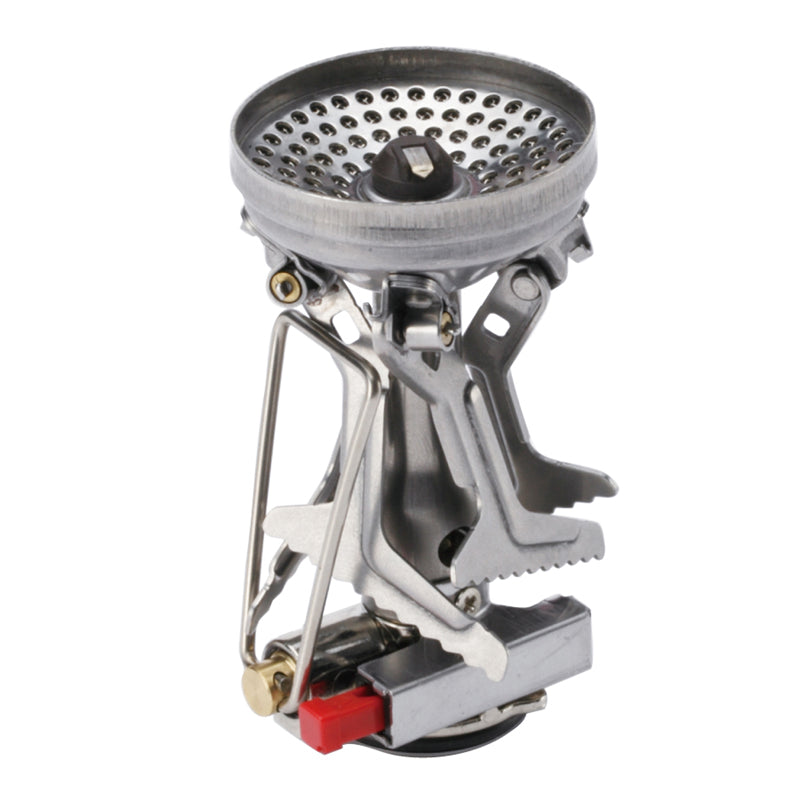
Overview
The Soto Amicus with Stealth Igniter (model OD-1NVE) is an upright canister stove that weighs 81 g and folds down to about the size of a small tea tin. It is built for three-season backpackers and thru-hikers who want a light, easy-to-use burner without paying for Soto’s regulated Windmaster. The trade-off is a valve with no regulator, so output fades in the cold and as the canister empties.
Key Specs
| Spec | Value |
|---|---|
| Model | OD-1NVE |
| Weight | 81 g (2.9 oz) |
| Output | 10,210 BTU / 2,800 kcal/h |
| Burn time | ~1.5 hours on an 8 oz (250 g) canister |
| Dimensions in use | 3.0 x 4.0 x 3.4 in (7.6 x 10.0 x 8.6 cm) |
| Dimensions stowed | 1.7 x 1.6 x 3.0 in (4.3 x 4.0 x 7.5 cm) |
| Fuel | Standard isobutane Lindal-valve canisters (Primus, Snow Peak, MSR, Jetboil) |
| Valve | Triple O-ring, unregulated |
| Ignition | Piezo “Stealth” igniter built into the burner post |
| Pot supports | Four, spring-loaded and foldable |

Build your Gear Closet
View all of your gear in one place, create packing lists and hit the trail with confidence. Available on iOS, Android and the web.
Get StartedPerformance
Wind
The burner head is concave and has a raised ledge around the crown. That shape holds the flame down and away from crosswinds, and it is the Amicus’s main selling point against flat-burner stoves at this weight and price. Testers at Outdoor Gear Lab found the design works in light to moderate breezes. They reported about a 20 percent drop in fuel efficiency and slightly longer boil times in that wind, and the stove still ran. Moderate to strong gusts blew it out, mostly at low simmer settings. A hiker who cooks on an open ridge will still want a rock, a pack or a windscreen. The usual caution about putting a screen close around a canister stove applies.
Boil time and fuel use
Outdoor Gear Lab’s testing puts a liter of water at a boil in about 3.5 minutes in standard conditions. One tester measured an average of 0.28 oz of fuel per boil. Efficiency is middle of the pack. Little heat is retained between burner and pot, so the Amicus behaves like other lightweight canister stoves. For one person boiling water for freeze-dried dinners and morning coffee, a 100 g canister typically lasts a few days.
Simmer control
This is where the Amicus beats most stoves at this price. The wire valve handle is long enough that a hand stays clear of the flame when a pot boils over. It turns smoothly and in small increments, which gives a wide range from a bare flicker to full roar. Hikers who cook more than boil-in-bag meals tend to cite this as the reason to choose it over cheaper stoves with twitchy valves.
Cold and canister depletion
The Triple O-ring valve has no pressure regulator. Soto’s Windmaster has a micro-regulator that keeps output steady as the canister cools or runs low. The Amicus does not. Below freezing, or with a nearly empty canister, flame strength drops. That is fine for summer and shoulder-season trips but a poor fit for winter camping or cold mornings at altitude.
Igniter
The Stealth Igniter runs through the center post, which shields it from knocks in a pack. Owners report it usually lights on the first or second click. It is also the part that wears out. Several long-term users describe it failing after extended use. A replacement piezo costs about €10 and is user-replaceable, but the sensible approach is to carry a lighter and treat the igniter as a convenience.
Pot stability and build
Soto gives the Amicus four pot supports, where most rivals have three. Each rotates out on a spring rivet and locks with a small tab and hook, so nothing detaches and gets lost in the dirt. Outdoor Gear Lab judged them sufficient for smaller pots and pans. With a 750 ml to 1 L pot the stove is steady. Past that, the short arms leave less margin, and a 2 L pot or wide pan starts to feel tippy. The stove looks slight, but owners report it surviving rough handling over many trips without visible wear.
Pros & Cons
Pros
- Concave burner with a raised ledge handles light and moderate wind better than flat-burner stoves
- Four spring-loaded pot supports are more stable than three-arm designs, and they can’t be lost
- Long valve wire and a smooth valve give wide-range simmer control
- 81 g with the igniter, and it stows very small
- Fits any standard Lindal-valve isobutane canister
- Igniter sits inside the burner post and can be replaced
Cons
- No regulator, so output fades in cold weather and with a low canister
- The piezo igniter can fail with heavy use, so a backup lighter is a must
- Short pot supports leave less confidence with pots over about 1 L
- Strong gusts still blow it out, especially on a low flame
- Fuel efficiency is average
Who Should Buy This
The Amicus suits three-season backpackers and thru-hikers who cook for one or two. It works best with a 750 ml to 1 L pot and a diet of boiled water, dehydrated meals and the odd real dinner. It is also a sound first canister stove or a lighter replacement for a heavier one. Winter campers, high-altitude trips and hikers who cook on exposed ridges should look at the Windmaster, which has a regulator and a more wind-resistant design.
Verdict
The Amicus does not lead its class on any single measure. It does well enough on wind handling, simmer control, weight and stability to be the stove most three-season hikers need. The igniter will eventually need replacing, but the stove itself is well built and cheap to run. For summer trips and shoulder-season hiking, buy it.