MSR Fuel Bottle Review
MSR's seamless aluminum liquid-fuel bottle comes in three sizes and pairs with every MSR pump stove; the child-resistant cap is the one sticking point.
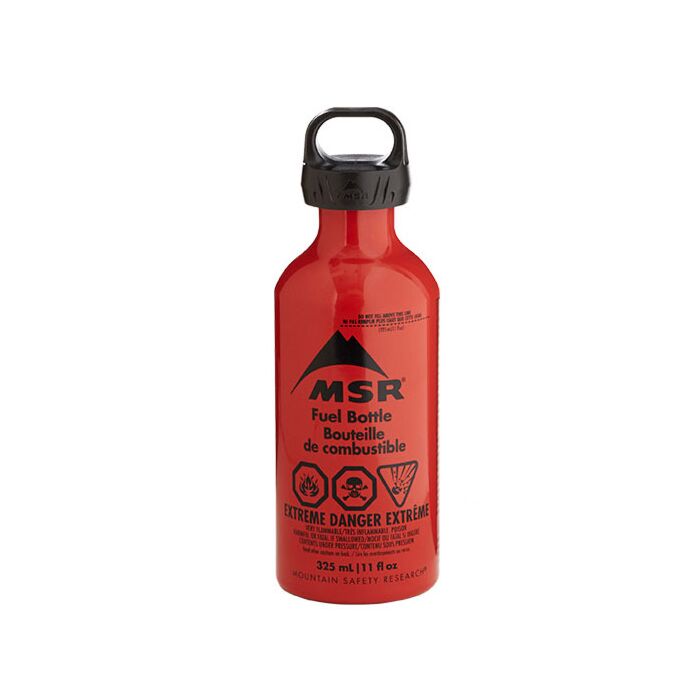
Overview
The MSR Fuel Bottle is the fuel tank for MSR’s pump-fed liquid-fuel stoves, including the WhisperLite, WhisperLite Universal and DragonFly. It comes in three sizes, 11, 20 and 30 fl oz, so fuel capacity can match trip length. The trade-off is a child-resistant cap that’s safer in a household and fussier on the trail, particularly in the cold.
Key Specs
| Spec | Value |
|---|---|
| Weight | 122–218 g (4.3–7.7 oz) depending on size |
| Capacity | 325–887 ml (11–30 fl oz) |
| Diameter | 2.5–3.1 in |
| Height | about 7 in (11 oz) to 11.3 in (30 oz) |
| Material | Impact-extruded aluminum |
| Cap | Child-resistant push-and-twist, vented for controlled pouring |
| Stove compatibility | Threads accept MSR fuel pumps |
| Fuels | White gas, kerosene, unleaded gasoline |

Build your Gear Closet
View all of your gear in one place, create packing lists and hit the trail with confidence. Available on iOS, Android and the web.
Get StartedPerformance
Build
The body is impact-extruded from a single piece of aluminum, so there are no seams or welds to fail. The shoulders and base are thicker than the sidewalls to resist bulging when the bottle is pressurized by a stove pump. The neck threads are machined into the bottle itself instead of using a pressed-in insert. That removes a failure that has plagued some competing designs, where the insert spins loose and the bottle can no longer seal.
Owners describe a bottle that shrugs off abuse. Drops from table height don’t produce leaks, and the realistic worst case from a hard knock is a dent rather than a crack. Bottles decades old turn up in trip reports and still work.
Fuel storage and capacity
The airtight seal makes the bottle suitable for storing fuel between trips, which matters because white gas degrades with prolonged air exposure. Refilling is the system’s main appeal. Any gas station can supply fuel, which makes a liquid-fuel setup practical in regions where isobutane canisters are scarce or can’t be flown.
Burn time depends on the stove, altitude, wind and what’s being cooked. One long-time WhisperLite owner reports that the smallest bottle covers about three days of cooking in mild winter conditions and about five in summer, at eight meals or hot drinks over that span. Melting snow changes the math quickly, since it can burn through a bottle in a day or two.
The cap
The cap divides opinion. The push-and-twist mechanism meets U.S. and Canadian child-resistance standards, and it is harder to work than the plain caps on older bottles. The problem gets worse if the cap is over-tightened. Experienced users say a snug, water-bottle-level turn is enough, because the mechanism won’t back off on its own. A cap cranked down hard can need a stick or multi-tool through the loop for leverage, which is a poor thing to discover at dusk.
Cold makes it worse. The spring-loaded mechanism stiffens in sub-freezing temperatures and is difficult to operate with gloved hands. Winter users warm it briefly with body heat or a splash of water. Few would call that a pleasant 5 a.m. routine in a snowstorm. On the plus side, the holes in the cap shaft allow a measured pour instead of a glug, and the printed fuel warnings make the bottle hard to mistake for a water bottle at camp.
Choosing a Version
Capacity per gram of bottle improves as the bottles get bigger. The 11 oz carries roughly 11 g of bottle per fluid ounce, the 20 oz about 8.4 g, and the 30 oz about 7.3 g.
- 11 fl oz (325 ml, 2.5 in diameter): The slimmest of the three and the one that slips into a standard pack side pocket. It suits solo weekends and shorter trips with an efficient stove. It also works as a top-off bottle next to a larger primary.
- 20 fl oz (591 ml, 2.9 in diameter): The sensible default for solo hikers on three- to four-day trips or anyone who cooks hot meals twice a day. At 167 g it’s the best balance of capacity and carry weight. It also beats two 11 oz bottles, which together weigh 244 g.
- 30 fl oz (887 ml, 3.1 in diameter): At 218 g and 11.3 in tall, it is built for groups, winter trips with snow melting and extended stretches between resupply. Its weight per ounce of fuel is the lowest. It’s also the bulkiest, and it may not fit a slim side pocket.
Pros & Cons
Pros
- Seamless, impact-extruded construction with a long record of durability
- Airtight seal suits fuel storage between trips
- Machined neck threads avoid the spinning-insert failure of some competitors
- Three sizes cover weekend trips through expeditions
- Runs on white gas, kerosene or unleaded gasoline
- Threads directly onto MSR fuel pumps
- Cap vents allow controlled pouring
Cons
- The child-resistant cap needs technique and can seize when over-tightened
- The cap stiffens in sub-freezing weather, when a liquid-fuel stove is most useful
- The 11 oz bottle weighs 122 g empty, a lot of dead weight for a short trip
- The 11 oz capacity runs short beyond a few days of solo cooking
- Only useful with a liquid-fuel stove
Who Should Buy This
Anyone running an MSR pump stove needs one of these, and the 20 oz suits most solo backpackers. The 11 oz is for short solo trips and international travel where refilling at a gas station beats hunting for canisters. The 30 oz suits groups and winter trips. Canister-stove users have no reason to buy it. Hikers new to liquid fuel should practice with the cap at home so it doesn’t surprise them in the field.
Verdict
The MSR Fuel Bottle is the standard liquid-fuel bottle. Its one-piece aluminum body, machined threads and airtight seal are well engineered and will probably outlast the stove it feeds. The cap is the only real annoyance, and it’s manageable once the owner stops over-tightening it. It loses points in deep cold. The 20 oz is the best choice for most hikers.