Totem Cam Review
The Blue 0.65 Totem Cam weighs 75 g and loads each lobe independently. It's a narrow-headed, flexible trad cam that holds in flared, awkward placements.
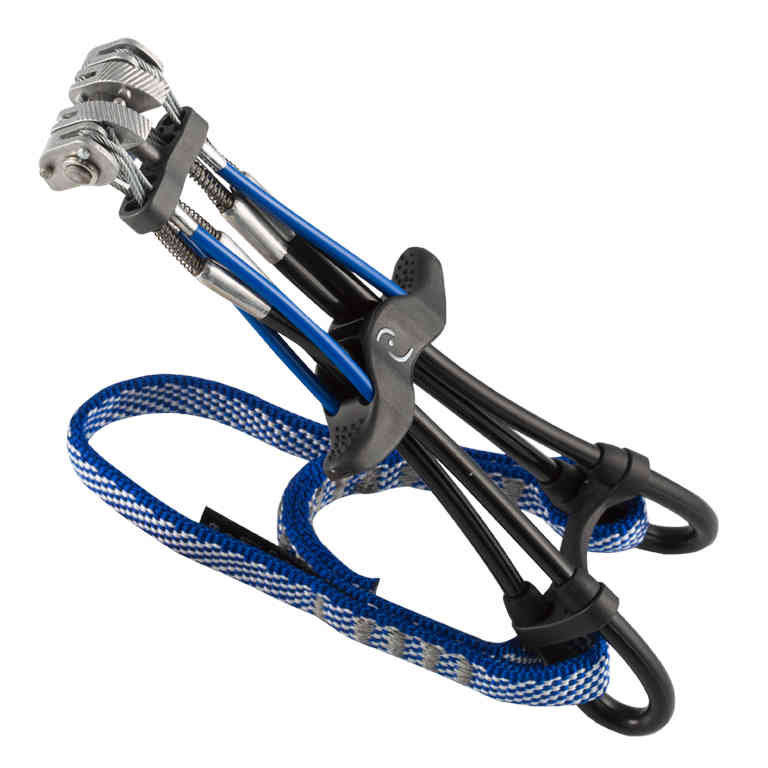
Overview
The Totem Cam is a Spanish-made, single-axle trad cam built around a patented Direct Loading system. Each of its four lobes has its own cable running to the sling, so the stem and axle don’t carry the fall load. The Blue 0.65 covers the fingertip-to-thin-fingers slot at 75 g. It costs more than most cams in its class, and it earns that price in the placements where ordinary cams get nervous.
Key Specs
| Spec | Detail |
|---|---|
| Size / color | 0.65 / Blue |
| Weight | 75 g (2.6 oz claimed) |
| Range | 13.8–22.5 mm (0.54–0.89 in) |
| Expansion ratio | 1.64:1 |
| Rated strength | 8 kN |
| Lobes / axle | 4 lobes, single axle |
| Stem | Flexible, double cable |
| Loading system | Direct Loading (US patent 7,014,156) |
| Certification | CE |
| Price | €116.95 inc. VAT from the manufacturer; the same figure appears in USD at some US retailers |

Build your Gear Closet
View all of your gear in one place, create packing lists and hit the trail with confidence. Available on iOS, Android and the web.
Get StartedPerformance
Holding power. The design is why the Totem exists. Because every lobe is tied directly to the sling, the load is split evenly across the lobes, so one lobe can’t sit idle while another takes the strain. Gripped Magazine’s testers tied the line’s 6–13 kN strengths to this system and reported an unusual level of confidence on slick Lake Louise quartzite. A Backcountry staff reviewer says the cams seat well in odd cracks, with lobes that keep working when the rock is less than ideal. UKC’s reviewers made the same comparison with conventional cams. They found better holding power and a narrower head.
Head width and small placements. The narrow head is the Totem’s best-known trait in the small sizes. UKC’s reviewers found it narrower than many micro cams, which helps in shallow pockets and thin seams. In the 0.65, the cam lands between a micro cam and a full-size one. A reviewer at Climbing Gear Reviews listed it as a rough match for a DMM 4CU 0 or a BD Camalot 0.3. That same reviewer found the Totem’s range far better than the DMM’s and close to the Camalot’s, without the weight of a double axle.
Flexibility and walking. The stem is cable-based and bends in every direction, and the sling is longer than most. Testers report less walking on wandering pitches and in horizontal cracks than with stiffer cams, and the trigger is easy to work with gloves on. UKC owners like the way the cams seat. The flexibility annoys some people, but the complaints are about the large sizes. Gripped’s testers found the Red 1.50 and Orange 1.80 too heavy-headed for the pliable stem. A 75 g Blue doesn’t have that problem.
Two-lobe loading. Any single lobe pair can be loaded alone. Totem rates this for aid and body-weight placements only, and the manufacturer says as much because the two-lobe mode has no CE rating. Outdoor Gear Lab named the Totems its favorite cams for aid climbing for this reason. Its testers scored them a 10 for aid but 7 for free climbing and 6 for weight. Free climbers can treat the feature as a rare way out of a bad spot, not something to fall on.
Weight. At 75 g, the 0.65 is a middling lightweight and not an ultralight standout. Gripped’s testers found the line on par with other non-ultralight options. Outdoor Gear Lab put the Totem 1.00 at 95 g, against 65.2 g for Metolius’s Ultralight cam. The Totem’s weight buys a longer sling, a wider range and independent lobes. Anyone shaving grams from a rack can spend them elsewhere.
Durability and caveats. Owners describe the cams as well made, and Outdoor Gear Lab scored durability 8 out of 10. One Backcountry reviewer gave a two-star review, calling the cams no better than standard BD or Wild Country cams. That reviewer also flagged an exposed-cable issue on the smallest size: cables protruding when the cam is retracted can abrade against the rock and fray over time. That report applied to the Black 0.50 and shouldn’t be taken as a verdict on the 0.65. Even so, routinely inspecting the cables on any Totem is sensible. The cams carry no passive strength, so they can’t be used as a nut in a pinch.
Pros & Cons
Pros
- Independent lobe loading gives strong holding in flared, slick or marginal rock
- Very narrow head for its size class
- 1.64:1 expansion ratio is generous for a single-axle design
- Flexible stem and long sling cut down walking and rope drag
- Two-lobe loading is available for aid and body-weight placements
- Easy to place and remove, even with gloves
Cons
- 75 g isn’t ultralight, and Metolius’s Ultralight cam is lighter
- Premium price, around €117 per cam
- Two-lobe mode isn’t rated for falls
- No passive strength
- The soft stem takes some adjusting for climbers used to stiff cams
- One owner flagged cable exposure and abrasion on the smallest Totem size
Who Should Buy This
Trad climbers who want one cam for the sketchy placements, which means limestone, slick quartzite and flaring cracks. It also suits aid climbers, who get the most from two-lobe loading, and mixed climbers who place gear with thick gloves. The Blue 0.65 fills the small-finger slot in a rack and can stand in for a micro cam when the crack is shallow. Weight-obsessed alpine climbers and anyone who wants stiff stems should look at lighter or more conventional cams. So should anyone who wants one cheap cam to cover everything.
Verdict
The Totem Cam 0.65 is a specialist’s cam that also works as a general rack piece. It holds in places where conventional cams don’t. The price is a premium cost and a weight that doesn’t qualify as ultralight. Trad climbers who run into marginal placements often should buy it.