Pedco UltraPod I Review
A 2 oz fiberglass-nylon mini tripod that's been a backpacker's pocket staple for decades — here's how it holds up for smartphones and light point-and-shoots.
Overview
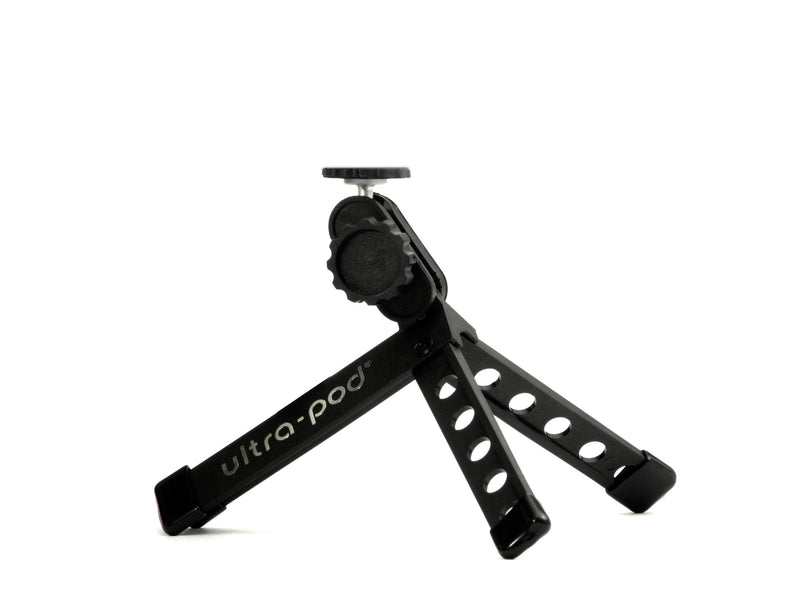
The Pedco UltraPod I is a tiny, fold-flat camera support that’s been kicking around outdoor and photo shops since long before “ultralight” was a marketing buzzword. At 56.7 g and folding down to just 4 inches, it’s built for hikers and travelers who want a way to prop up a phone or compact camera without dedicating pack space to a real tripod. It’s not going to replace a proper tripod for serious photography, but for trailside timelapses, self-timer summit shots, and the occasional astro attempt with a light camera, it’s a legitimate tool that a lot of long-time users still reach for.
Key Specs
| Spec | Value |
|---|---|
| Weight | 56.7 g (2 oz) |
| Folded length | 4 in |
| Standing height | 5 in |
| Load capacity | 3 lbs |
| Pan adjustment | 360° |
| Tilt adjustment | ±90° |
| Angular adjustment | ±20° |
| Material | Fiberglass-reinforced nylon, aluminum-threaded components |
| Mount | Standard 1/4”-20 tripod screw |
| Attachment strap | Removable Velcro “One-Wrap” fastener |

Build your Gear Closet
View all of your gear in one place, create packing lists and hit the trail with confidence. Available on iOS, Android and the web.
Get StartedPerformance
The UltraPod I’s whole reason for existing is the ball-and-socket head paired with three L-shaped legs that fold flat against the body. The legs are L-shaped and either fold out like a standard tripod or bundle up into a single stack, and both formations can be used. That dual-mode design is the real trick here — you can set it up as a mini tabletop tripod on a rock or picnic table, or wrap the Velcro strap around a trekking pole, fence rail, or tree branch and use it as an improvised clamp mount. On trail, I’ve found the strap-mount mode more useful than the tripod mode; flat, level surfaces are rare in the backcountry, but trees, signposts, and pack frames are everywhere.
For load capacity, Pedco rates the UltraPod I at 3 pounds, constructed from molded fiberglass reinforced nylon with aluminum-threaded components. That’s realistic for a smartphone or a small point-and-shoot, but you’ll want to size up if you’re running anything heavier. Users of the larger UltraPod II — rated for 6 lbs — still report it struggling with full DSLR setups; one Adorama reviewer said the tripod could not handle a 5-pound 6D with a Tamron 24-70 lens well and returned it. That’s a stronger unit than the UltraPod I, so treat the “3 lbs” rating on this smaller model as a hard ceiling, not a suggestion — stick to phones, GoPros, and compact cameras.
Stability is where the UltraPod line earns its reputation. On the Backpacking Light forums, a longtime user comparing it to the Joby GorillaPod noted the Pedco is quite stable, and that stability doesn’t degrade with age the way rubber ball-joint tripods sometimes do. Multiple reviewers who’ve owned both the UltraPod and GorillaPod side by side actually prefer the Pedco for exactly this reason — the rigid ball-and-socket head doesn’t get “floppy” over time the way GorillaPod’s bendable legs can. On the flip side, that rigidity means less flexibility for wrapping around irregular objects; the GorillaPod wins on deployment speed since you don’t have to unwind a Velcro strap first, a tradeoff one forum poster called out directly.
The non-slip feet are a small but appreciated detail — the feet of the UltraPod are covered with non-slip vinyl, preventing the tripod from moving, which matters more than you’d think on smooth rock or a picnic table edge. One long-term reviewer of the larger UltraPod II, after two and a half years of use across 13 countries, put the core tradeoff well: you give up a ton of the adjustable features of a standard tripod, as well as a kit quick-release, but what you drop in size and weight more than makes up for it.
Where it falls short: there’s no independent leg-length adjustment, so if you’re on an incline, you’re relying entirely on the ball head to level things out, not always enough on steep terrain. And because it packs so small, the head has limited leverage — cranking down the ball-socket tension enough to keep a heavier device from slowly drooping under its own weight takes a firmer hand than you’d expect from something this size (a complaint echoed by owners of the beefier UltraPod 3 as well).
Pros & Cons
Pros
- Genuinely pocketable — folds to 4 inches and disappears into a hip belt pocket or shirt pocket
- Dual-mode design (tabletop tripod or strap-mount clamp) covers more real-world situations than a fixed tripod
- Rigid ball-and-socket head stays stable and doesn’t loosen up over years of use the way flexible-leg alternatives can
- Standard 1/4”-20 mount means it works with phones, GoPros, and compacts via the right adapter
- Non-slip vinyl feet add real security on hard, smooth surfaces
Cons
- 3 lb capacity is a hard limit — no room for anything beyond a phone or light point-and-shoot
- No adjustable leg length, so leveling on uneven ground is entirely on the ball head
- Strap deployment is slower than clip-style alternatives like the GorillaPod
- Some long-time GorillaPod-and-UltraPod owners still prefer the GorillaPod overall for backpacking use
Who Should Buy This
This is the right pick for smartphone photographers, GoPro users, and light point-and-shoot shooters who want a self-timer or timelapse option without adding meaningful pack weight. If your kit is a mirrorless body with any real glass on it, look at the UltraPod II or a small carbon tabletop tripod instead — you’ll bump into the 3 lb ceiling fast.
Verdict
The UltraPod I does one job well: giving ultralight hikers a nearly weightless way to stabilize a phone or small camera in more places than a flat tabletop tripod could manage. It’s not the fastest to deploy and it’s strictly limited to lightweight gear, but its decades-long staying power in backpacker gear closets says something about its durability and usefulness. I’d rate it a 7/10 — a smart, cheap addition to a photography-minded ultralight kit, as long as you respect its weight limit.